Every romance author has been told to build a platform. A brand. An online presence. A following. Yet none of those are what romance readers are actually looking for — and this gap between what authors are told to build and what readers want is the main reason why most romance author marketing fails. Here’s what changes when you stop building a platform and start creating a storyworld.
The Wrong Question at the Center of Author Marketing
The question most romance author marketing education asks is: “How do I build an audience?”
That’s the wrong question. And once everything is built from it, the whole structure points the wrong way.
An audience is a group of people who follow a creator. They come for the creator’s personality, perspective, expertise, or entertainment. They stick around because the creator continues to deliver whatever drew them in the first place. The creator is the product.
Romance readers are NOT searching for a “creator” to follow. They’re NOT looking for a personality to be entertained by. They’re NOT looking for an expert whose knowledge they want access to.
Romance readers WANT A WORLD TO INHABIT!
This isn’t a metaphor. Readers describe their reading experience in exactly those terms — they speak of being inside a story, of living inside a world, not wanting to leave a world, and mourning when that story ends. The book hangover is the clearest evidence of this: the specific, emotional distress a reader feels when a world ends and she doesn’t know how to leave it.
Every romance author who has readers experiencing this book hangover, has already done the most important thing. She’s built a world her readers don’t want to leave. The question is whether she has built somewhere for them to go AFTER they finished??
Most have NOT! Because they were taught to build a platform, not a storyworld.
What a Platform Is and Why It Fails Romance Readers Specifically
In the traditional author marketing sense, an author’s platform is the collection of digital webpages where an author maintains a presence: a website, social media accounts, an email list, a newsletter. It’s the online real estate. It’s required and necessary.
But a platform is oriented toward the author (author-facing). It showcases the author’s books, news, life, and voice. The reader who lands on this platform is there to experience the life of the author.
A storyworld is oriented toward the reader (reader-facing). It presents the emotional experience of the world the author has created — the characters, the vibe, the sensation of being inside that storyworld — in a way that gives the reader MORE of what she already loves. The reader who lands on a storyworld is there to “live inside” more of the world she’s already chosen.
These are NOT simply alternative forms of the same thing. They’re different architectures altogether, and they create different reader experiences entirely.
The reader who arrives at a platform after finishing a book she LOVED finds an author bio, a list of books, and a social media feed about someone’s writing life. She’s been moved from “I loved this world” to “here’s the author who write it.” That move is a step backward from the emotional state she came in with. She WAS immersed. Now she’s watching from the outside.
The reader who arrives at a STORYWORLD after finishing a book she LOVED finds MORE of the world she just left! More of the characters she just fell in love with. The behind-the-scenes story of the creative decisions that shaped the world she loves. The atmospheric content drops her back into the feeling she came from. And the reader magnets that extend the world beyond the book. She stays deeper. She goes deeper.
The book hangover reader came looking for MORE! The storyworld supplies it. The platform gives her info about the author who created it.
Why Romance Reader Attach to Worlds, Not Authors
This is the distinction everything else hangs on, and it’s the one most author marketing advice gets completely wrong.
Romance readers do NOT primarily attach to authors. They attach to worlds. To characters. To emotional experiences. To the distinct emotional feeling living inside a particular kind of story.
Attachment to the author comes second — and it only develops when the author’s world has become real enough that the reader wants to know the person who built it. The world comes first. The author relationship follows. Not the reverse.
This is why a romance author who builds her marketing around herself — her personality, her opinions, her life, her creative process — is asking readers to be interested in her before they have a reason to be. She’s proposing on page three. The slow burn hasn’t started yet.
A romance author who centers her marketing on her storyworld — the characters, the emotional atmosphere, the precise feeling of being inside the storyworld she built — is giving readers what they already want. She’s writing the chapters that produce the relationship before she asks for anything.
The reader who’s spent days, even weeks in an author’s storyworld — who’s read every single article, downloaded the reader magnets that expand on your storyworld in some way, and moved through the welcome sequence that made her feel understood — has already formed the attachment. The relationship exists because the world was there to inhabit.
This is the reader attachment model that creates the loyal FTM reader, the advocate, the reader who buys everything without needing to be sold to. And it begins with the storyworld, not the author’s personality.
The Book Hangover as the Proof and the Problem
The book hangover is the most honest signal in romance book marketing. It tells an author exactly what she produced and exactly what she did NOT provide.
When a reader is in a book hangover, she has fully experienced the world enough to feel its loss. She loved the characters. She was immersed in the atmosphere. She believed in the community or the setting or the emotional truth of the story. SHE DOES NOT WANT TO LEAVE!!!
And most of the time, there’s nowhere for her to go.
She finishes the book. She checks out the author’s website. She finds a bio and a buy link. The world she was just inside is GONE — not because the author didn’t build more of it into her books, but because she never translated what she built into a storyworld, an ecosystem, the reader could in habit between and beyond the books.
The storyworld is the answer to the book hangover. Not the cure — readers who love a world should feel its loss, because that feeling is real and it’s the most valuable emotional signal an author can create. But the storyworld, the online ecosystem, is where the reader in a book hangover can find more. More characters. More atmosphere. More of the feeling she does NOT want to leave.
When you build a storyworld, you answer the book hangover reader at her peak of investment with exactly what she’s looking for, in the place she already went to look for it.
The Slow Burn and the Storyworld: How they Work Together
The slow burn marketing strategy — the model that treats the reader relationship as a romance story arc — has its own required setting.
A slow burn romance needs a contained world. The characters must keep running into each other somewhere. The small town they cannot escape. The office they share. The place where forced proximity keeps happening until tension turns into something real.
Your storyworld is that contained world.
Without it, the slow burn marketing has no setting. A reader who sees your social content once and then clicks to a website that gives her nowhere to go has experienced a noticing moment — she saw you from across the crowded room — but the meet-cute never occurs because there’s no contained world for it to happen in. She returns to scrolling. The story never begins.
With a build storyworld, every element becomes a scene in the slow burn. The blog article about your MMC is the moment she notices something she didn’t mean to notice. The reader magnet is the meet-cute — the first moment of felt connection with your world that she cannot reverse. The welcome sequence is the forced proximity — she’s in your inbox now, receiving more of the world before anyone has asked her for anything. The Reader Hub is the setting where she keeps coming back to because the world keeps giving her more.
The storyworld is NOT merely a helpful addition to your marketing strategy. It’s the setting that makes the slow burn possible. Without it, there’s nowhere for the relationship to develop.
Why this Is Categorically Different from What’s Being Taught Now
The traditional author marketing framework teaches: share your personality, build an audience, be consistent, show up.
This framework was built for creators who sell themselves. It works for coaches, educators, influencers, and entertainers whose personality IS THE PRODUCT!
This does NOT work for romance authors specifically because romance readers are NOT mainly looking for a creator’s personality. They’re looking for an emotional experience — and that emotional experience lives in the world the author built, not in the author’s daily life or content creation process.
The BFF Strategy’s storyworld framework differs in one foundational way: it puts the storyworld at the center of everything, not the author. Every piece of content, every reader magnet, every email, every page of the website is oriented toward giving the reader more of the world she came for.
That changes the content question from “what should I share about myself today?” to “what part of my storyworld can I share today that my readers haven’t seen yet?”
It changes the website question from “how do I present my books professionally?” to “how do I build an online environment that feels like being inside my storyworld?”
It changes the email question from “what do I have to announce?” to “what part of my storyworld can I give my readers more of today?”
It changes the business model question from “how do I sell my books?” to “how do I give readers more world to invest in — and ensure that investment exists in forms they can purchase?”
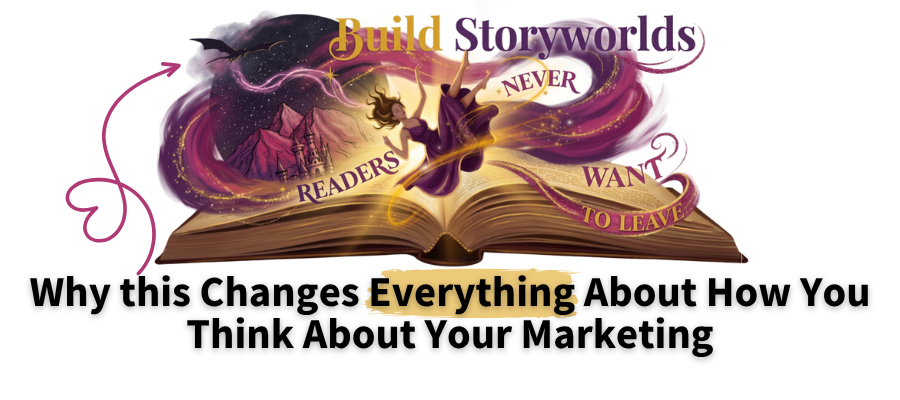
This is what “Build Storywords Readers Never Want to Leave” actually means as a marketing strategy. Not a tagline. A complete reorientation of every decision an author makes about per platform, her content, and her ecosystem.
The next article in this series shows what that ecosystem looks like when it’s actually built — every element, what it does, and why it all has to carry the same atmospheric identity to function the way it was designed to.
Where to Go Deeper
The Perspective Gap: Why the Direction Your Content Faces Changes Everything About Whether Readers Stay — The structural explanation for why author-facing content fails the reader who arrived looking for more world — and what world-facing content does differently.
The Book Hangover Is Not a Problem to Solve — It’s a Reader Telling You Exactly What She Needs Next — The book hangover as the clearest signal in romance marketing — and what it reveals about what readers are searching for when they come to your website after the last page.
Your Romance Author Marketing Should Be a Slow Burn — and You’ve Been Writing the Wrong Book — Why the storyworld is the setting the slow burn marketing arc requires — and why without it the story can’t develop past the noticing phase.
Shental is a romance reader with more than 30 years of reading experience, having read 3,000+ romance novels. She’s also the creator of the BFF Strategy™ — the first reader-first ecosystem framework for romance authors, built from inside the reading experience.


