Most romance authors think of reader magnets as single assets — you create one thing, you offer it once, and you move on to the next idea.
That’s not how the most effective reader magnet ecosystems work.
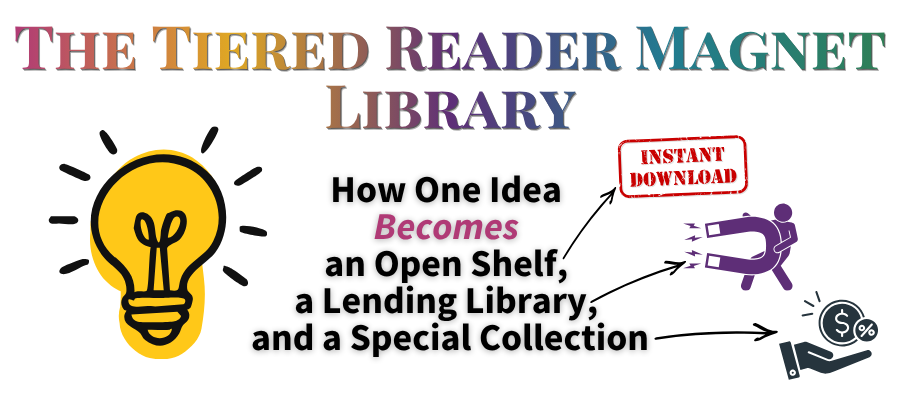
Almost every magnet idea you have contains three versions inside it.
One version belongs in your Reader Experience Hub, free for any reader to browse.
One version belongs in your email system, free but gated — a download a reader signs up to receive.
And one version belongs in your shop, a fully designed, collectible, premium product for your most invested readers.
This isn’t three different products built from scratch. It’s one idea, expanded at three levels of depth and value. The community map you sketched in your notebook while plotting your series isn’t just a fun detail. It’s an Open Shelf graphic, a printable Lending Library download, and a 24×18 Special Collection poster — all from the same source material.
Understanding this structure changes how you plan your magnet suite entirely. You stop thinking about individual assets and start thinking about a tiered library where every reader finds something at the depth she’s ready for.
Why the Three-Tier Structure Exists
Romance readers don’t all arrive at the same depth of investment at the same time.
A reader who just discovered you through a social post isn’t in the same place as a reader who finished your entire series last week and is actively searching for more. A new reader browsing your website needs different things than a superfan who’s already bought everything you’ve published and wants a keepsake to frame.
The tiered structure serves all three of them from the same creative material.
The Open Shelf serves the browsing reader — someone curious enough to look but not yet ready to commit. She can see your world without giving anything in exchange.
The Lending Library serves the reader who’s decided she wants more — she’s willing to sign up to your email list in exchange for something she can hold and use.
The Special Collection serves the superfan who wants the best version of everything you’ve created — something beautifully designed, high-resolution, and worth paying for.
The tiers don’t compete with each other. They work in sequence. A reader who encounters your Open Shelf version often becomes the reader who signs up for the Lending Library version. A reader who loves the Lending Library version becomes the reader who buys the Special Collection.
Each tier does its own job and feeds the next one.
The Three Tiers Defined
The Open Shelf — Free and Ungated
The Open Shelf is the version of your magnet that lives in public — on your Reader Experience Hub, embedded in blog posts, shared on social. No email address required. No barrier of any kind.
Open Shelf assets are smaller, simpler, and optimized to load fast and display well on a screen. Their job is orientation and curiosity, not immersion. They give a reader just enough of the world to want to go deeper.
This version is free not because it’s less valuable, but because it’s the invitation. It’s the sample on the welcome desk. The reader who finds it is encountering your world for the first time or exploring it at the surface level. The Open Shelf doesn’t ask anything of her — it just shows her what’s there.
Open Shelf assets are short and visual: a small character profile card, a simple web-optimized community map, a one-page series overview, a single timeline graphic.
Easy to load. Easy to share. Easy to understand in 30 seconds.
The Lending Library — Free and Gated
The Lending Library version is the deeper, more detailed, downloadable version of the same asset. This is the version a reader receives in exchange for her email address — delivered in your welcome sequence after she signs up.
Where the Open Shelf gives her a glimpse, the Lending Library gives her something she can hold. It’s printable. It’s designed for 8.5×11 or letter-size download. It has more detail, more depth, more immersion. It’s the asset she can keep, print, and return to.
The Lending Library is where the email relationship begins. The transaction — her email address in exchange for your asset — is a moment of trust and commitment on both sides. She’s saying she wants more of your world. You’re delivering on that promise with something genuinely worth having.
Lending Library assets include: character dossiers for one couple from one book, a full printable community map, a bundled set of deleted scenes, a reading order guide formatted for printing, a character quote journal sized for home printing.
The Special Collection — Paid
The Special Collection is the premium version. Fully designed. High-resolution. Collectible. This is the asset your superfans want because they’ve loved your world long enough to want to own a piece of it.
Special Collection assets are larger, richer, and more expensive to produce — and appropriately priced to reflect that.
A community map becomes a 24×18 poster a reader can frame.
A character profile becomes a full-color dossier bundle covering every main couple across the series.
A timeline becomes a large-format illustrated print.
The Special Collection also includes bundles — multiple premium assets combined into a curated experience. A series survival kit. A complete character bundle. A storyworld companion guide. These are the products that earn revenue from readers who already love everything you’ve built.
One Idea Across All Three Tiers: The Community Map
The clearest way to see how this works is through a single example traced through all three levels.
Your series is set in a specific town. You’ve named the streets, placed the landmarks, described the ranch on the east side and the diner on the main strip and the blind curve on the road out. In your notes, you have a rough sketch of how it all fits together.
That sketch is the source material for three versions of the same asset.
The Open Shelf version is a small, clean web graphic of the town map — enough detail to feel real, enough warmth to feel inviting. It lives on your Reader Experience Hub under a heading like “Explore [Town Name].” Any reader can see it. No sign-up required. A new reader arriving at your hub sees it and understands: this world has geography. There’s a real place here to inhabit.
The Lending Library version is the printable 8.5×11 version of the same map — more detailed, labeled, designed with your brand colors. It includes the locations where key scenes in the book happen, notes about each landmark, and the emotional significance of each place woven in. A reader signs up to your email list and receives it in her welcome sequence. She prints it, keeps it beside her while she reads, and reaches for it again when she starts the next book in the series.
The Special Collection version is the 24×18 poster version — professionally designed, high-resolution, suitable for framing. It covers the entire series, not just one book. Every significant location across all 14 books is marked. It’s a piece of art that belongs to the world she loves. She buys it from your shop for $19 to $27, frames it, and tells everyone who asks about it where it came from.
Three versions. One source. Each one serving a different reader at a different level of attachment.
How to Build in Sequence
The most common mistake is trying to build all three tiers at once. That’s not how the system is designed to work, and it’s not how the reader journey works either.
Build in sequence: Open Shelf first, Lending Library second, Special Collection third.
Start with the Open Shelf. Before you build anything downloadable, build the public-facing version of your asset and put it on your website. This serves readers who are already arriving at your site and gives the Lending Library version something to upgrade from. It also tells you which assets readers respond to — the community map that gets the most engagement on your Hub is the magnet that’s worth upgrading to a full Lending Library download.
Build the Lending Library next. Once you know which Open Shelf assets your readers are drawn to, build the detailed, printable version and set up the sign-up sequence to deliver it. This is where your email list grows — not from a random freebie, but from a deeper version of something readers already told you they wanted by engaging with the Open Shelf version.
Add the Special Collection last. The Special Collection is for readers who already love your world. You can’t build superfan products before you have superfans. Wait until you have readers in your email list who have been with you through at least one full welcome sequence. Then offer them the premium version of the asset they’ve already seen and loved. The conversion rate will be higher because they already know what the world feels like — the Special Collection just gives them more of it at the highest quality level.
What This Means for Your Product Suite
The tiered library system is how magnets become revenue without requiring you to build entirely new products.
Everything already in your story — maps, timelines, character details, deleted scenes, reading order guides, cast lists — can exist at all three levels. The emotional investment your reader has in your world is already there. The tiered system gives her three different ways to act on it, at three different levels of commitment.
This is the BFF Strategy’s secondary income principle in practice: the creative IP you built when you wrote your books is the raw material for a complete product suite. You don’t need to create new worlds. You need to build out the world you already have — at the depth your readers are ready for.
Where to Go Deeper
The full architecture for building your magnet library — including every tier, every magnet type, and the complete sequence for connecting it to your welcome system and your shop — is inside the BFF Playbook.
And if you want to see how a reader who signs up for your Lending Library magnet moves through your entire ecosystem — from that first download all the way to your books, your hub, and your shop — that’s the next article in this series.
→ The Magnet-Funnel-Binge Flow: How One Download Leads to the Whole World
Shental Henrie is a 30+ year romance reader who has read 3,000+ romance novels and is the creator of the BFF Strategy™ — the first reader-first ecosystem framework for romance authors, built from inside the reading experience.