A reader finds your magnet. She signs up. She downloads it.
Now what?
If the answer is “she gets an automated delivery email and then nothing for three weeks until you remember to send a newsletter” — that’s where the reader relationship stalls. Not because she isn’t interested. Because the path from that download to your books, your world, and your deeper content wasn’t built.
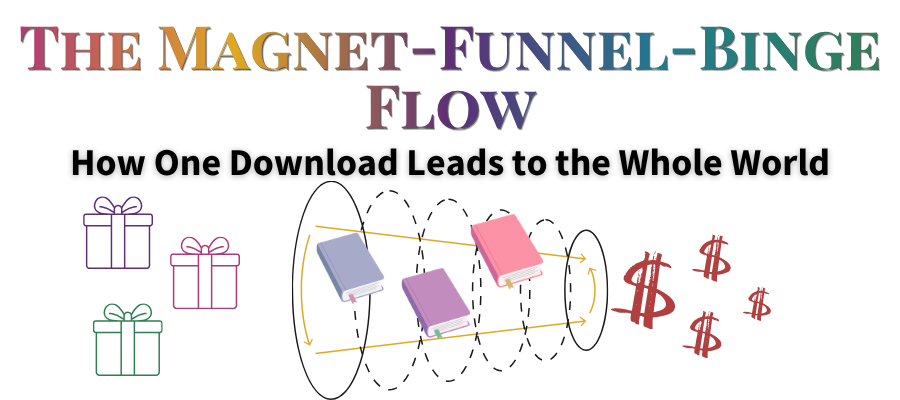
The Magnet-Funnel-Binge Flow is the name for the complete journey a reader takes from her first download all the way to your books, your Reader Experience Hub, your booklist, and conversion. It’s the connective tissue of your reader magnet ecosystem. And when it’s built correctly, a reader who downloads your community map on a Tuesday has read your first book by Friday and is already planning her way through the series.
Here’s how the full flow works, and what each stage needs to do its job.
The Magnet-Funnel-Binge Flow at a Glance
Magnet → Welcome Sequence → Storyworld Orientation → Booklist and Hub → Binge → Attachment → Conversion → Loyalty
Each stage has one job. None of them can skip ahead, and none of them should try to do the work of the stage before it.
A reader who downloads your magnet isn’t ready to be sold to — she’s ready to be welcomed.
A reader who’s been in your welcome sequence for a week isn’t ready for a superfan bundle — she’s ready to explore your books.
The flow respects the reader’s timing. It doesn’t rush her. It guides her.
Stage 1: The Magnet Creates the First Emotional Spark
The magnet isn’t just a list-building tool. It’s the first moment of real emotional connection between a reader and your world.
When a reader downloads your reading order guide, she’s already decided she wants to binge your books — she just needs to know where to start.
When she downloads your character dossier, she’s already emotionally attached enough to want more of that specific person.
When she downloads your community map, she’s already imagining herself inside the world you built.
The magnet that converts is the one that’s built for the desire already present in the reader. It’s not introducing her to the world — it’s giving her more of the world she’s already curious about. That’s the emotional spark the rest of the flow is built on.
This is why the magnet you offer matters as the entry point. A generic freebie — something disconnected from your storyworld — doesn’t create this spark. It creates a transaction. And a transaction doesn’t lead to a binge.
Stage 2: The Welcome Email Is the Relationship’s First Real Moment
The welcome email is the single most underestimated piece of the entire ecosystem.
Most romance authors treat the welcome email as a delivery mechanism — a template that says “here’s the thing you signed up for, thanks for joining.” It delivers the asset and stops there. The reader receives her download, reads it, and then has no idea what to do next. The momentum from her sign-up — the curiosity and desire that made her download in the first place — dissipates while she waits for the next email that may or may not come.
The welcome email has a different job. It’s the moment a curious reader becomes an emotionally invested one.
In the Library Analogy, this is the midpoint shift — the note that makes her think “this author actually knows me.” The welcome email should feel like a personal welcome into the world, not an automated acknowledgment of a transaction. It delivers the asset, yes. But it also introduces the emotional atmosphere of your world, gives her one clear next step, and makes her feel that she arrived somewhere worth staying.
The welcome email should do four things:
➡️ deliver the magnet warmly and without friction,
➡️ introduce the emotional identity of your world in two or three sentences,
➡️ give her one specific next step (not three — one),
➡️ and invite a response.
That invitation — “reply and tell me which character you’re most curious about” — is the thing that turns an email address into the beginning of a relationship.
Stage 3: The Welcome Sequence Orients Her to the World
The welcome email is the first touch. The welcome sequence is the complete orientation.
A five-email welcome sequence, sent over the course of one to two weeks, does the work of introducing a new reader to everything she needs to go deeper into your world. Not everything about your world — that would overwhelm her.
The specific things she needs to feel at home: who the characters are, what the emotional experience of your books is, how many books exist and where to start, and where to go when she wants more than what the books contain.
The sequence follows a natural arc.
- Email one delivers and welcomes.
- Email two introduces the world’s emotional atmosphere and links to the Reader Experience Hub.
- Email three introduces a character — one character, with a hook and a quote, linked to that character’s book page.
- Email four explains the reading order and links to the Author Booklist.
- Email five is the binge invitation — a warm, clear, unhurried message that says: here’s where everything is, here’s where to start, and I’m glad you’re here.
By the end of the sequence, a reader who came in through a single magnet download has been introduced to your world’s emotional identity, at least one character she’s been given reason to care about, the full scope of your backlist, and the three places on your website most worth visiting.
That’s orientation. That’s what turns a one-time download into a reader who’s ready to binge.
Stage 4: The Hub and the Booklist Are Where Bingeing Begins
The welcome sequence points readers somewhere. Where it points them matters.
The two destinations that do the most work at this stage are your Reader Experience Hub and your Author Booklist Page.
The Reader Experience Hub is the immersive part of your website — the space where a reader can go deeper into your world without buying anything. Maps, timelines, character extras, behind-the-scenes notes, aesthetic content. It’s the cozy reading nook in the back of your bookstore. A reader who arrives here is in exploration mode. She’s asking: what else is here, what is this world made of, is there enough to stay a while? The Hub answers that question.
The Author Booklist Page is the navigation layer. It shows her the full scope of your world in one place: every book, organized by series, with reading order clear and unambiguous. A reader who arrives at the Booklist is asking: where do I start, and how many books can I read before I run out? A well-built booklist with covers, reading order, and brief series notes answers both questions in under a minute and sends her directly into the binge.
These two pages work together. The Hub deepens attachment. The Booklist activates behavior. A reader who visits the Hub first and the Booklist second is warmer when she reaches the Booklist — she’s already more emotionally invested than a reader who arrives cold. The welcome sequence creates the warmth.
The Hub deepens it. The Booklist converts it into action.
Stage 5: The Binge Is What the Whole Flow Was Building Toward
When the flow works, a reader doesn’t consciously move through a funnel. She just reads.
She downloads the magnet because she wanted more world. The welcome email made her feel welcomed. The sequence introduced her to a character she now cares about. The Hub deepened her sense of the world’s texture and atmosphere. The Booklist showed her exactly where to start. And now she’s reading the first book.
The binge behavior that follows — reading book two, then three, then searching your Hub for character extras between releases — isn’t a marketing outcome. It’s what happens when a reader who already had desire for your world was given a clear, frictionless path to more of it. The flow didn’t create the desire. It honored it.
This is the reader-first principle applied at the systems level. The magnet didn’t push her. The welcome email didn’t sell to her. The sequence didn’t pressure her. Every step gave her something she already wanted and showed her where to go next. The result is a reader who binged your entire series and feels like she found you herself — because in the most meaningful sense, she did.
Stage 6: Attachment Leads Naturally to Conversion
A reader who has binged your series, visited your Hub multiple times, and been in your welcome sequence is a reader with deep emotional attachment to your world. She’s not a cold prospect being sold to. She’s a superfan looking for more.
This is the stage where your paid products make sense to offer. Not before. Not during the welcome sequence. After the attachment has been built.
The conversion step in the flow is gentle because it doesn’t have to be anything else. A reader who loved your books and found your community map in the Hub has already been thinking about the Special Collection poster without knowing it existed. An email that mentions “I just added the 24×18 community map to the shop — it’s the one from your Hub, fully designed and ready to frame” doesn’t feel like a sales pitch. It feels like news she’s been waiting for.
The product offer that comes after genuine attachment converts at a fundamentally different rate than one offered to a cold subscriber.
This is why the flow matters.
The conversion isn’t at the end because the author decided to sell at the end — it’s at the end because that’s when the reader is ready.
Stage 7: Loyalty Is What the Ecosystem Produces
The reader who moves through the full flow doesn’t just buy and leave. She stays.
The ecosystem loop — email to Hub to blog to shop to email — keeps her connected between book releases. She comes back to the Hub when she wants to reread favorite scenes. She opens your emails because they’ve consistently given her more world without pressuring her. She buys the Special Collection products when they’re released because she’s been invested in this world long enough to want a keepsake.
And she tells people.
Word of mouth — the advocacy that no marketing budget can buy — comes from readers who were served this well.
Not from readers who were targeted and converted. From readers who felt genuinely welcomed into a world that was built for them, given a clear path to more of it, and shown that the author cared about their experience of the world.
That’s what the Magnet-Funnel-Binge Flow produces when it’s built with the reader’s journey in mind.
Not a list. A community of readers who never really want to leave.
What to Build First
If you’re looking at this flow and feeling the gap between where you are and where this describes, start with the magnet and the welcome email. Those two pieces, done well, are enough to begin. You don’t need the full website built, the Hub populated, and the shop stocked before you launch.
The FREE Starter Pack gives you the four orientation magnets and the welcome email templates to begin the flow immediately.
The complete working reference for every element of this ecosystem — with descriptions of each page, each platform, and each tool — is in the free FREE Reader-First Author Platform Guide. Download it, keep it beside you, and use it as your building checklist.
And for the full architecture — every stage of the flow mapped to your reader journey, with the email sequences, the Hub structure, and the product suite — that’s inside the BFF Playbook.
Shental Henrie is a 30+ year romance reader who has read 3,000+ romance novels and is the creator of the BFF Strategy™ — the first reader-first ecosystem framework for romance authors, built from inside the reading experience.


