There’s a part of your author business that runs while you write.
Not in theory. Not with the right hustle mindset. Literally, mechanically, automatically — while you’re writing the next chapter, the nurture sequence is running. A reader who signed up last Tuesday is receiving her third email today. She doesn’t know you set this up six months ago. She experiences it as you showing up consistently, knowing what she wants, giving her more of the world she signed up to explore.
This is the nurture sequence: the automated email series that follows the welcome email and runs for every new subscriber in the same order, on the same schedule, indefinitely. Once you build it, it needs no maintenance except occasional updates as your world grows. It is the most leveraged work you will do in your entire author business.
The Principle That Governs the Whole Sequence: One Topic Per Email
Before the structure, the principle — because it changes how every email in the sequence is written.
One email. One topic. One clear next step.
This isn’t a stylistic preference. It’s the most important structural decision in email marketing for romance authors, and here’s why.
A reader who opens your email and finds one clear, complete thing — a character introduction, a world extra, an invitation to the community — has a simple and satisfying experience. She got something specific. She knows what to do next. She may act on it or not, but the email was clear and easy.
A reader who opens your email and finds four things — a character introduction, a new release mention, a social media link, and a product recommendation — has to decide what to pay attention to. Most of the time, she pays attention to nothing and moves on. The email technically contained more, and she received less.
One topic means every email is a small, complete interaction. The sequence is a series of small, complete interactions. The relationship builds through accumulation, not through information density.
The Complete Nurture Sequence Structure
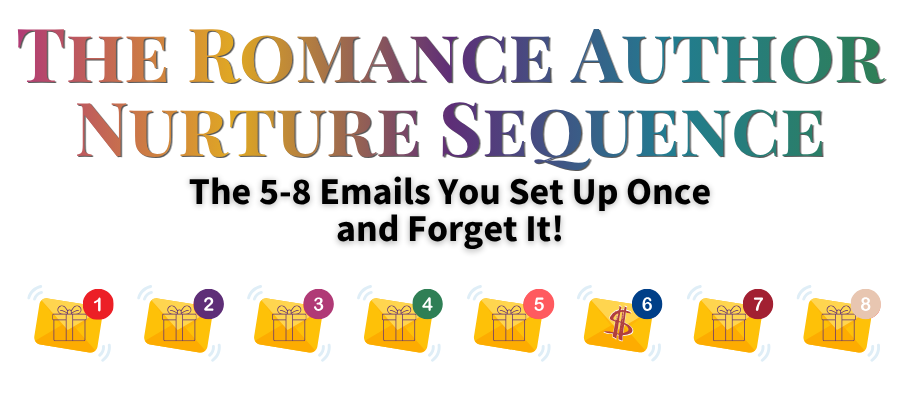
The BFF Strategy nurture sequence is 5-8 emails, spaced two to four days apart, each with one job. Here’s the full sequence with every email’s topic, emotional function, and the single next step it offers.
Email 1 — The World Introduction
Topic: The emotional atmosphere of your world — not the plot, the feeling.
This email introduces the world itself as an emotional environment. Not “my series is set in a small Montana town.” The feeling of being in your world: “There’s a particular kind of quiet in Harlow Creek, Montana, the kind that has nothing to do with volume and everything to do with the weight of what people choose not to say out loud.” That sentence is the world, experienced.
One world detail, described in atmospheric language. One link to the Reader Experience Hub, framed as “this is where more of the world lives.” One teaser for the next email.
Emotional function: she starts to feel the world before she’s committed to reading the books. The NTM reader who’s still deciding gets the atmospheric confirmation she needed.
Email 2 — The Character Introduction
Topic: One character. One hook. One attachment point.
This email introduces one main character — the MMC of Book 1, or whoever is most likely to produce an attachment response in a new reader. Not a biography. A hook: who he is in the way that matters emotionally, what wound he carries, what quality she’ll notice in the first chapter that will stay with her for the whole book.
One character quote, if you have one that shows his voice without spoilers. One link to the book page for his book. One teaser for the next email.
Emotional function: she is now attached to a fictional person who didn’t exist in her awareness 72 hours ago. This is the meet-cute working at the character level — she’s not just curious about your world, she’s curious about him specifically.
Email 3 — The Free World Extra
Topic: A second free magnet, offered here with no signup required — she’s already subscribed.
This is the free-within-the-sequence extra: something that extends the world she’s just been introduced to. A deleted scene. An alternate POV snippet. The community map. A character mood board. A short piece of behind-the-scenes content. It should match the character or world angle she just encountered in Email 2 — the natural next thing she’d want after the character introduction.
Deliver it directly in the email or via a link to a page where it lives. No second signup required. She already gave you her email. Asking her to sign up again to receive something in the middle of a sequence she’s already in is friction that serves no one.
One world extra, delivered warmly. One invitation to reply with what she loves about this type of character or world. Replies are conversation starters — and replies to marketing emails significantly improve deliverability.
Emotional function: she has now received two free things after the magnet. The reciprocity is building. The trust is building. The sense that this author understands what she wants and keeps delivering it is building.
Email 4 — The Reading Order and Binge Invitation
Topic: Where to start, how to continue, and how much world exists.
This email answers the Stage 2 Curiosity question that she’s almost certainly been sitting with since Email 1: how many books are there and where do I start? Give her the complete answer clearly and warmly.
The reading order for your primary series, briefly described. A link to the Author Booklist page for the full picture. A “start here” recommendation for the reader who’s now ready to commit to Book 1.
The emotional function of this email is binge activation. A reader who’s been through three emails of world immersion and now sees a well-organized, accessible path through a full series of books she’s already emotionally primed for will frequently go straight to Book 1 from this email. The sequence has done the slow burn work. This email is the grand gesture.
Email 5 — The Community Welcome
Topic: The community exists, you belong in it, here’s the door.
If you have an active community — Discord, Facebook group, email community — this is where you introduce it. Warm, specific, low-pressure. She’s been in your world for nearly two weeks. She knows the characters, she knows the world, she knows the reading order. If there’s a place where people who love this world gather, she’s now emotionally ready to be told about it.
One sentence about what the community is and what happens there. One link to join. One note that she’s under no obligation — this is an invitation, not a requirement.
If you don’t have a community yet, replace this email with a second character introduction (a secondary character, or the FMC of Book 2) or a second world extra. The sequence needs to keep giving before it asks — skipping this email and jumping to the paid offer breaks the pacing.
Email 6 — The First Paid Offer
Topic: A specific, world-connected paid product at a low ticket price.
This is the first time in the entire sequence you’ve asked for anything beyond an email address. She has received: the magnet, an emotional world introduction, a character hook, a free extra, a reading order, and (if applicable) a community invitation. She has been in your world for 10-14 days. She’s warm, attached, and oriented.
The offer is small and specific: a $1.99 to $7 product directly connected to the character or world elements she’s been introduced to in this sequence. The character dossier. The community map. A short extra collection. Something she will recognize as “more of exactly what I’ve been getting” rather than “something being sold to me.”
One product. One clear description in emotional language (“for readers who want to know everything about Sebastian before they start the book”). One link to your shop. One note that there’s no pressure — this exists if she wants it and will be there when she’s ready.
Emotional function: buyer identification. The reader who purchases here has told you something important about her attachment level. The reader who doesn’t isn’t rejecting you — she’s simply at a different stage. Both responses are information.
Email 7 — The Book Recommendation
Topic: The book itself — the reading experience, not the plot.
This is the email that recommends the specific book she should start with, described in reader-first language. Not “Fighting for Us is a second-chance romance set in Montana.” The emotional experience: “Fighting for Us is for the reader who needs proof that the love she gave up on finds its way back — and for the reader who’s always believed that a man who loves quietly, before he says a word, is the most devastating kind.”
This email doesn’t hard-sell. It describes. A reader who has been through this sequence and resonates with that description will go find the book. A reader who isn’t ready yet will file it for when she is.
One book. One emotional description. Links to wherever she can find it — your shop first if you sell direct, retailers second.
Email 8 — The Ongoing Invitation
Topic: What comes next — how to stay connected and what to expect.
The final email in the automated sequence transitions her from the structured sequence into the ongoing relationship. It tells her: you’re now part of my world, here’s what that means. Here’s what she can expect going forward (emails when something new exists, not constantly). Here’s the best way to stay connected (the Hub, the community, the blog). Here’s an invitation to reply and tell you one thing she loved about what she found.
This email closes the formal sequence and opens the ongoing relationship. After this, she moves from the automated sequence into your broadcast email list — the non-automated emails you send when you have something worth sharing.
The Sequence Is a Set-and-Forget System — With One Exception
Once built, this sequence runs automatically. Every new subscriber enters Email 1 and moves through the sequence in order on the schedule you set. You never need to think about it again — except when your world grows.
When a new book releases, update Email 4 (the reading order) and Email 7 (the book recommendation) to reflect the new addition. When a new character becomes fan-favorite, update Email 2. When you launch a community, update Email 5. Otherwise, the sequence runs as built.
This is the leverage: one build, infinite deployments. The author who spent three hours building this sequence last October is still delivering a complete, warm, world-immersive experience to every reader who signs up today, without touching it.
What This Sequence Is Not (And What Broadcast Emails Are)
The nurture sequence is automated, evergreen, and subscriber-specific. Every reader gets the same emails in the same order regardless of when she subscribed.
Broadcast emails are different: they’re one-time sends that go to your full list simultaneously. A new release announcement. A behind-the-scenes update. A timely community post. A seasonal promotion. These are NOT part of the nurture sequence — they sit alongside it, sent manually when you have something worth sharing.
The distinction matters: the nurture sequence runs whether you show up or not. Broadcast emails require you to show up and write them. Both are part of a complete email strategy. This article covers the sequence. Broadcast emails — what they are, when to send them, and 15 ideas for what to include — are covered in their own article so the strategic distinction stays clear.
Where to Go Deeper
The welcome email article that precedes this sequence covers the single most important email in your entire strategy — the one that arrives right after signup and determines whether the relationship begins or doesn’t. Reading that one first gives the nurture sequence the foundation it needs to work.
The free-to-paid psychology article explains why the sequence is structured the way it is — why three free things precede the first paid offer, and why that ordering produces readers who buy willingly rather than reluctantly.
The Magnet-Funnel-Binge Flow article shows how the complete email sequence connects to the Hub, the booklist, the shop, and the ongoing reader relationship — mapping the full mechanical pathway from first signup to loyal reader.
Shental Henrie is a 30+ year romance reader who’s read 3,000+ romance novels and is the creator of the BFF Strategy™.


