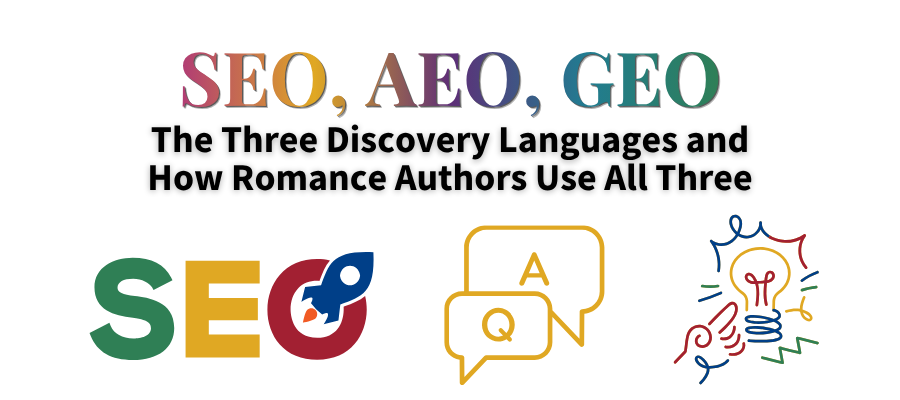
There are three assistants working in the mainland library right now. Each one is trying to help readers find books. Each one listens differently, searches differently, and makes decisions based on completely different signals.
The Cataloger categorizes everything by what it structurally is.
The Concierge matches readers to worlds by vibe and atmosphere.
The Book Whisperer listens to how a reader feels and finds the story that will reach her where she is.
Most romance authors are only talking to one of them. A few are talking to two. Almost none are giving all three what they need — which means almost every romance author is invisible to at least two of the three mechanisms that determine whether readers find her books.
Here’s what each one is, what it needs from you, and why romance authors specifically cannot afford to ignore any of them.
Why There Are Three — and Why All Three Have Changed
Five years ago, the primary discovery mechanism for most online content was SEO — search engine optimization. A reader typed something into Google. Google returned a list of links. She clicked. The end.
That model still exists. But the discovery landscape has expanded significantly, and understanding what replaced “just SEO” isn’t optional for romance authors building platforms in 2026.
Interest media — social platforms with their own internal algorithms — became a major discovery layer. TikTok, Instagram, Pinterest, and YouTube each have recommendation engines that surface content to users based on behavioral signals, not just search queries. A reader doesn’t always search for your books. Sometimes she stumbles across a reel about your characters and falls in love before she ever intentionally looked for you.
AI-powered answer engines changed search behavior. When a reader asks ChatGPT, Google’s AI overview, Perplexity, or TikTok’s search function for a recommendation, she’s not getting a list of links. She’s getting a curated answer built from signals the AI has aggregated across the internet. If your content is part of that signal landscape, you get recommended. If it isn’t, you don’t exist in that search result.
These three layers — SEO, AEO, and GEO — are not replacing each other. They’re operating simultaneously. And each one uses a different part of your Semantic Fingerprint to decide whether your storyworld belongs in the answer it gives the reader.
The Cataloger — SEO and Your Structure
What it is: Search Engine Optimization. The oldest and most established of the three discovery layers. This is how Google, Bing, Pinterest search, and YouTube search organize and rank content.
How it thinks: literally and categorically. The Cataloger reads your content the way a librarian reads a spine — what genre does this belong to, what subjects does it address, what search terms does it contain, and how authoritative is this source based on the citations pointing to it. It does not read nuance. It reads signals.
What it needs from you: your Structure keywords, deployed consistently and correctly. Genre, subgenre, tropes, story elements, series names, format. These are the words that place your content on the right shelf in the right room in the right wing of the library. “Small town western romance enemies to lovers second chance” placed in your URL, your page title, your first paragraph, and your subheads tells the Cataloger exactly where your content belongs.
The Cataloger also needs your owned assets — your blog posts, your website pages — because it cannot reliably index social media content. An author with a large Instagram following and no author blog has an audience the Cataloger has never heard of. Her TikTok content lives in a closed system. The Cataloger cannot reach it. Everything she built there is invisible to Google search.
Why this matters for romance authors specifically: romance has the most specific and searchable vocabulary in fiction. Readers use trope names, heat level language, subgenre descriptors, and character archetypes as search terms. They type “grumpy sunshine small town romance” and “protective MMC spicy contemporary romance” with genuine search intent. An author whose content consistently uses this vocabulary on owned, indexed assets is being shelved in exactly the places those readers are looking.
The one thing the Cataloger cannot do: understand feeling. It cannot tell a reader searching for “a book that made me feel safe” what your novel would do to her heart. That’s the Concierge’s job.
The Concierge — AEO and Your Chemistry
What it is: Answer Engine Optimization. The layer that serves readers who ask specific, contextual questions and receive curated answers rather than lists of links. Google’s AI Overviews, TikTok search, Pinterest Lens, YouTube AI recommendations, and AI assistants like Gemini and Perplexity all operate at this layer.
How it thinks: contextually and atmospherically. The Concierge doesn’t just match keywords. It understands the meaning behind keywords — the specific aesthetic, atmosphere, setting, and sensory context a reader is describing.
When a reader says “I want something that feels like a rainy October night in a small town with slow burn tension and no explicit content” she’s not giving the Cataloger a search query. She’s giving the Concierge a description of a feeling she wants to inhabit. The Concierge matches her description to content whose language describes that same feeling.
What it needs from you: your Chemistry keywords, specifically and richly. The setting details. The atmospheric descriptors. The sensory language. The heat level vocabulary. The vibe words that paint the reading experience before the reader opens the first page. “Montana ranch autumn harvest season, cozy and slow, tension that builds for three hundred pages before it breaks” is Chemistry language. The Concierge files it accurately and retrieves it when a reader’s description matches.
Chemistry keywords live in your book descriptions, your social captions, your blog post body copy, your website’s book pages, your email storytelling, and your image alt text. Every piece of descriptive language you use that places your reader inside the atmosphere of your world is a signal the Concierge is collecting.
Why this matters for romance authors specifically: romance readers are masters of atmospheric description. They know they want “the one where she’s trapped with the grumpy guy who won’t admit he’s been watching her for months.” They know they want “small town series with a big ensemble cast and a slow drip mystery thread running underneath all the love stories.” These descriptions are Chemistry searches. An author whose content uses the same atmospheric language her readers use is being matched by the Concierge every time one of those readers asks for a recommendation.
The one thing the Concierge cannot do: reach the reader who doesn’t know what she wants — only how she feels. That’s the Book Whisperer’s territory.
The Book Whisperer — GEO and Your Heart
What it is: Generative Engine Optimization. The newest and most emotionally sophisticated of the three discovery layers. This is how AI tools — ChatGPT, Claude, Gemini, Perplexity, and AI search features embedded in social platforms — understand and recommend content when a reader is searching not for a thing but for an experience.
How it thinks: emotionally and meaningfully. The Book Whisperer doesn’t look at the catalog. It looks at the heartbeat of your story. When a reader says “I’ve had a really hard year and I just need a book that makes me feel like things are going to be okay,” she is not asking for a genre. She is asking for an emotional outcome. The Book Whisperer reads the Heart signals in your content — your emotional tone, your promise to the reader, your branded emotional language — and finds the story that most closely matches what she needs to feel.
What it needs from you: your Heart keywords — the emotional language that lives at Levels 7, 8, 9, and 10 of the keyword system. The emotional experience the reader will have. The reader identity she carries when she’s looking for this book. The branded emotional language that is uniquely yours. The transformation the story delivers. “For readers who need proof that hope finds you even in the wreckage” is a Heart signal. “Grief healing romance that gives you all the feelings without spice” is a Heart signal. “The kind of book you read when you need to remember that love actually does happen” is a Heart signal.
Heart keywords are the most personal and specific of the three layers — and therefore the most powerful at the GEO level, because no two authors can have exactly the same emotional promise. Your Heart language belongs in your book descriptions, your social captions, your email subject lines, your website’s about page and book pages, and especially your blog content, where the emotional language has the most room to compound into authority.
Why this matters for romance authors specifically: romance is the genre most driven by emotional outcome. Readers choose romance books primarily based on how they want to feel — and they increasingly tell AI tools what they need emotionally rather than what genre they want structurally. An author whose content is saturated with Heart language is positioned to be recommended every time a reader describes an emotional need that her books can meet.
This is the most underused discovery layer in romance author marketing and the one with the largest current opportunity.
Why Romance Authors Need All Three
The temptation is to pick one. To decide that SEO is what matters, or that the AEO layer is the future and everything else is old thinking, or that since AI is everywhere now you should focus only on GEO.
All three are running simultaneously. They serve the same reader at different moments of her search behavior.
The same reader might search Google for “small town cowboy romance second chance” (Cataloger).
Ask Pinterest for “aesthetic cozy autumn romance vibes” (Concierge).
And type into ChatGPT “I just lost my dog and I need a book that will make me cry the good kind of cry” (Book Whisperer).
All three of those searches could find the same book — if its marketing covers all three layers.
➡️ An author who speaks only to the Cataloger misses her in the first two searches.
➡️ An author who speaks only to the Book Whisperer has beautiful emotional language that never gets indexed correctly by Google.
➡️ An author who speaks only to the Concierge is matching vibes without the structural labels that let the Cataloger file her correctly.
Your Semantic Fingerprint — the three-layer architecture of Structure, Chemistry, and Heart deployed consistently across every piece of content — is the tool that feeds all three simultaneously.
Not three separate strategies. One language system applied consistently in three different registers.
The Practical Starting Point
You don’t need to master all three at once. You need to understand what each one requires and make sure your content isn’t ignoring any of them.
Audit your last ten pieces of content against these three questions.
➡️ Does this post contain at least one Structure keyword — a specific genre, subgenre, trope, or series name?
➡️ Does it contain at least one Chemistry keyword — an atmospheric descriptor, a setting detail, a heat level signal?
➡️ Does it contain at least one Heart keyword — an emotional experience, a reader identity, a feeling the book delivers?
If every piece of content you create passes this audit, all three assistants can work with it. That’s the goal — not technical perfection, but consistent language architecture that gives every discovery mechanism what it needs to surface your world to the reader who’s already searching for it.
Where to Go Deeper
For the complete vocabulary map — what specific words belong at every level of your Semantic Fingerprint across all three pillars:
→ BFF Keyword System Master Guide → ($27)
For how the Semantic Fingerprint compounds over time across all three discovery layers:
→ The Semantic Fingerprint: Why Consistent Keyword Language Compounds Over Time
For the complete discovery and platform architecture that makes all three layers work together:
Shental Henrie is a 30+ year romance reader who has read 3,000+ romance novels and is the creator of the BFF Strategy™ — the first reader-first ecosystem framework for romance authors, built from inside the reading experience.