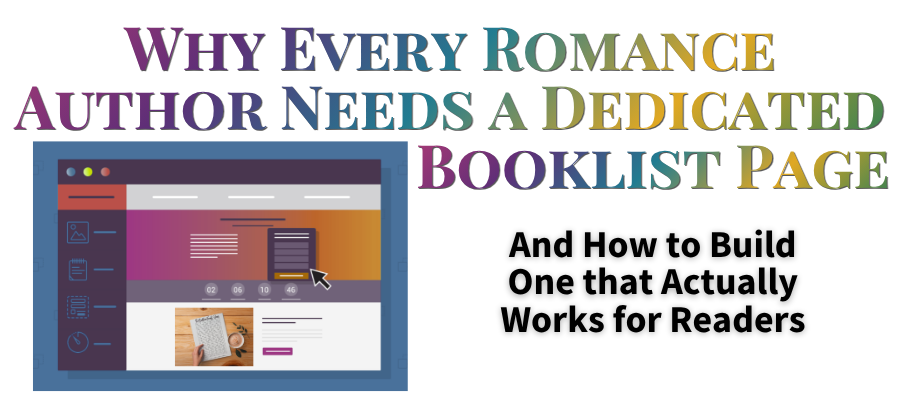
An author booklist page isn’t just an inventory of your titles. Built correctly, it’s the store map that turns a reader who’s interested into a reader who cannot stop. Here’s everything that goes on it, how to organize it, and how to make it work as both a website page and a reader magnet.
Here’s something I know as a romance reader that most author marketing advice gets backwards.
When I find an author I love — when I finish a book and immediately want everything she’s ever written — the first thing I do is go looking for the complete list. Not to browse. To plan. To see how much world exists and figure out exactly where I need to start and where I’m going after that.
If that list is easy to find, clearly organized, and tells me what I need to know to begin — I start reading. Immediately. The next book is downloading before I have put my phone down.
If it’s not — if the titles are in publication order with no reading guidance, if the series connections are unclear, if I cannot quickly figure out which characters appear in which books — I spend a few minutes trying to work it out. Then I give up and look for the next author whose world is easier to enter.
This isn’t me being difficult reader. This is me responding to the presence or absence of reader-first design.
The booklist page is where binge reading is won or lost.
What an Author Booklist Page Actually Is
An author booklist is a dedicated page on your website — not an Amazon page, not a Goodreads list, not a sidebar widget — that serves as the complete, organized guide to everything you have written.
Its job is orientation. It exists to answer every question a reader might have about your catalogue before she has to ask it. Where do I start? What order do I read these in? Whose story is in each book? What kind of world is this? Is this a standalone or do I need to read the series in order?
The booklist page is what the BFF Strategy calls the store map — the page that makes every book you have written findable, navigable, and irresistible to the reader who is ready to commit to your world.
It serves two completely different readers simultaneously.
The New-to-Me reader has no context. She may have read one book or found you through a recommendation. She needs orientation — a clear entry point, series organization that makes sense, and enough information about each book to know whether this is for her.
The Familiar-to-Me reader has read everything and wants to know what she’s missed and what’s coming. She uses the page as an inventory — checking what’s new, confirming the reading order for a re-read, finding the series thread information that deepens her understanding of the world she loves.
One page. Both readers. Both leaving with what they came for.
What Goes on Your Author Booklist Page
Every entry on the booklist page needs enough information to orient the reader without overwhelming her. Here is what belongs on every entry:
- Book title and series title together — listed clearly, both the individual book title and the series name it belongs to. If a book is a standalone, label it as such. Readers sorting by series need this immediately visible.
- Reading order number — within each series, numbered clearly. This is the single most important organizational decision on the entire page. Readers do not want publication order. They want reading order. Publication order serves the author’s timeline. Reading order serves the reader’s experience. These are not always the same, and the reader needs the one that helps her.
- Character names — first and last name for the main couple in each book. Romance readers follow characters. They finish Book 1 and immediately want to know which secondary character gets their own story. Seeing names on the booklist creates anticipation and connection before the reader has opened the book.
- Trope and theme — the primary emotional dynamic in plain language. “Slow burn enemies to lovers” communicates more than a tag. The reader who’s in a specific mood self-selects immediately.
- Heat band signal — a brief, honest indication of where the book sits on the heat spectrum. This is a promise. Low spice. Open door. Steamy. Explicit. The reader who needs a clean romance and finds a high-heat book without warning does not come back. The reader who receives accurate heat information trusts you. Include it here so it’s part of the navigation.
- Genre and subgenre — one or two words. Contemporary, historical, paranormal. Necessary for navigating a mixed catalogue.
- Brief emotional hook — not a blurb, not a plot summary. One sentence that tells the reader what this book’ll do to her emotionally. “For the reader who needs to believe it is not too late.” “A slow burn that earns 300 pages of tension in a single scene.” This is Level 7 keyword language on the booklist page — the emotional search string made visible at the point of browsing.
- Cover image — essential for visual recognition and aesthetic browsing. Readers often identify series by cover family. The covers on the booklist page should look like the series they represent.
- Standalone guidance — at the series level, a single line that tells the reader whether books must be read in order, are richer in order but work alone, or can be read in any sequence.
What not to include: publication date. Publication date is author information, not reader information. A reader does not choose a book because it was published in 2021 versus 2023. She chooses it because of who’s in it and how it’ll make her feel. Replacing publication date with the emotional hook serves her better in every case.
Reading Order as the Primary Organizing Principle
The single most important decision in building a booklist page is to organize by reading order, not publication order.
Publication order is when you wrote and published the books.
Reading order is the sequence in which a reader will have the richest experience of the world.
These are sometimes the same. Often they are not — especially in series where a prequel was written after Books 1 through 5, or where a spin-off works best read after the main series.
The reader who finds a publication-order list has to do the work of figuring out reading order herself. She may get it wrong. She may read a book that spoils a reveal she was supposed to encounter three books earlier. She may abandon the series because the experience felt disjointed.
The reader who finds a reading-order list gets the experience the author intended. She follows the story arc as it was designed to be followed. She encounters revelations in the right sequence. The world makes emotional sense.
Build the booklist in reading order. Every time. For every series. This is the most direct application of reader-first design on the entire website.
The Three-Format Booklist System
The booklist page is one expression of the booklist. But the booklist itself — the organized list of books with the information readers need — also exists as a reader magnet, in three formats, each serving a different reader at a different moment of her relationship with the world.
Format One: The Simple Text Booklist (Ungated — Free Download)
A clean, text-based version of the complete reading order. No color, no images, easy to print. Available as a direct download on the booklist page and the Reader Experience Hub without requiring an email address.
This version is ungated deliberately. The reader who cannot find the reading order is a reader who already wants more of the world and has hit a practical obstacle. She shouldn’t be asked to trade her email address to navigate to more books she’s already committed to reading. Give it freely. Remove the friction. The email comes later, in exchange for something she desires rather than something she needs.
The ungated version is also the most shareable format. Readers share it in book clubs. They link to it in reading challenge posts. They send it to friends. It earns organic reach from the readers who find it most useful — which is all of them.
Format Two: The Upgraded Booklist (Gated — Email Required)
The visually beautiful version. Book covers, branded design, the complete reading order in a format that is worth keeping and returning to. Available in exchange for an email address.
The reader who downloads this version isn’t solving a navigation problem. She already found the reading order. She downloads this because she wants the pretty version — because having your book covers, the series visual identity, and the complete designed document makes her feel more ownership over the world she loves.
This is a desire-led reader magnet. The email she gives in exchange is a declaration of belonging.
Format Three: The Checklist Booklist (Gated — Email Required)
The same reading order and series information, formatted as a checklist with boxes to tick as each book is completed.
The checklist turns the reading experience into a progress journey. Every book she finishes is a box she checks. Every unchecked box is a visible pull toward the next one. The reader who downloads this and starts marking off books is tracking her relationship with the world — and the uncompleted checklist keeps her coming back.
This version is also shareable in reader communities, reading challenge groups, and series tracking threads.
An author whose series has a checklist gets added to reading challenge lists. An author without one does not.
How the Three Formats Fit Inside the Funnel
The three-format booklist answers the New-to-Me reader’s most important discovery question: “how much of this world exists and how do I navigate it?”
Ungated simple version: no friction, maximum reach, immediate navigation. Lives permanently on the website.
Gated cover version: email exchange, desire-led, beautiful ownership experience. Lives in the email opt-in sequence.
Gated checklist version: email exchange, gamified, binge activation. Lives in the Funnel Starter Pack and the Reader Experience Hub.
Together the three formats constitute a complete reader orientation tool that serves the NTM reader discovering the world for the first time, the FTM reader returning to check what she has missed, and the book hangover reader looking for every piece of the world she can find.
All three formats are included as customizable Canva templates in the BFF Funnel Starter Pack. The simple text version is available as a free download — no email required.
Making the Page Discoverable
The booklist page earns SEO and compound authority through the character names, trope language, and emotional hook language on every entry.
- Every character name is a searchable term for the reader who loved the previous book and is looking for the next character’s story.
- Every trope label is an emotional keyword that matches reader search strings.
- Every heat band signal is the vocabulary readers use when they are filtering by reading experience rather than by genre.
The booklist page is NOT just a navigation tool. It’s a keyword-rich, reader-facing document that earns citations from reader communities who share it, link to it, and reference it in their own content.
Update it every time a new book publishes. A freshly updated page sends a signal to search engines that the site is active and the content is current. It also gives FTM readers a reason to check back regularly — they know the page reflects the complete world as it currently stands.
Your Free Simple Booklist Template
As a romance reader and the creator of the BFF Strategy, I built the simple text booklist template because I wanted every author to have an immediate, free tool for giving her readers exactly what they need — without any barrier between them and more of her world.
The template is free. No email required. You will find versions in Google Docs, Canva, and Microsoft Word — whichever format fits your workflow.
Download the free simple author booklist template here!
For the designed cover version and the checklist version, both available as customizable Canva templates, those are inside the BFF Funnel Starter Pack.
The complete ecosystem this page belongs to — all seven core pages of the romance author website and how they connect — is in Your Itty-Bitty Bookstore: What Your Author Website Is Actually For.
The Reader Experience Hub — where the three booklist formats live alongside the rest of the world-extension content — is covered in BFF University Module 2, Platform and Ecosystem.