The reader who loved your book is ready to read everything you’ve written. The question is whether your booklist page is built to receive her — or whether she’ll spend ten minutes trying to figure out where to start and leave without beginning.
Imagine this: a reader who just finished your book. It’s midnight, it’s dark, it’s quiet.
She loved it. She’s in a full book hangover state — your storyworld is more real to her right now than her actual life, and she’s not ready to leave it. She goes to your website looking for more.
She finds your books page.
There are twelve books listed. They are in publication order. There’s no indication of which series connects to which, which ones should be read together, where to start if she’s new, or what the reading order is for the interconnected family saga she just fell into the middle of.
She spends eight minutes trying to figure it out. She can’t figure it out. She closes the tab.
She didn’t leave because she didn’t want your books. She left because the cognitive friction of navigating your backlist was just high enough that giving up was easier than continuing.
This is the store map problem. And it costs you readers who were already sold.
What the Booklist Page Actually Is
The booklist page is NOT a catalogue. It’s NOT a list of your titles with buy links. It’s NOT your Amazon page replicated on your own website.
The booklist page is your store map — the complete, clearly organized guide to everything in your world, designed specifically to make binge reading as easy as clicking a single button.
Its job is to answer every question a reader might have before she has to ask it. Where do I start? What order do I read these in? Are these standalones or do they need to be read in sequence? What if I’ve already read some? What connects to what?
A reader who arrives at a well-built booklist page should leave with a clear reading path, a sense of the full world that exists and how large it is, and the specific next step that takes her from visitor to reader to binge reader without a single moment of confusion.
This is the orientation function. And it serves both reader types simultaneously.
The NTM reader arrives not knowing where to start. The booklist page is her roadmap — it tells her which entry point is right for someone completely new to this world, what the first book promises, and what lies ahead if she loves it.
The FTM reader arrives knowing she loves your storyworld and wanting to know what she’s missed, what’s coming, and how it all connects. The booklist page is her inventory — the complete record of everything that exists and everything she hasn’t yet read.
One page. Both readers. Both served.
What Goes on the Booklist Page
Every booklist entry needs enough information to orient a reader without overwhelming her.
The core elements that belong on every entry:
- Book title — the exact title, formatted consistently, linked to the individual book page or directly to purchase.
- Series title — clearly labeled so a reader can immediately see which books belong together. If a book is a standalone, label it as such. Readers searching for series binge potential need to see it at a glance.
- Reading order number — within a series, this is non-negotiable. Number one through whatever. A reader who has to guess whether Book 3 comes before or after Book 4 will guess wrong often enough that it matters.
- Character names (first and last) — the MMC and FMC for each book. Romance readers choose by character attachment. Seeing the names tells her immediately whose story this is and whether it is a character she has been waiting for since a previous book.
- Genre/subgenre — one or two words. Contemporary, historical, paranormal. Necessary for readers navigating a mixed catalogue.
- Trope — the primary trope or two, named clearly. Not as tags, but as natural language. “Slow burn enemies to lovers” communicates more than a tag list. The reader who is in a specific trope mood self-selects immediately.
- Heat band signal — a brief, honest indication of where the book falls on the heat spectrum. One to two words or a simple phrase. “Low spice,” “open door,” “steamy,” “explicit.” This is the promise that the reader trusts you to keep. It belongs here so it is part of the navigation, not just the individual book description.
- Reading order guidance note — at the series level, not just the book level. A single line that says “best read in order” or “standalones that are richer read in sequence” or “can be read in any order, but reading order reveals the series arc” tells the reader what she needs to know before she decides where to start.
- Contact information — where readers can go to follow you and find out what else you offer. This isn’t your personal email address or even your phone number, this is the links to your social media handles (especially handy when these are different) and to your website.
All of this, organized by series, with standalone books clearly separated and identified, in reading order within each series, and with a recommended entry point for new readers clearly marked.
This is your store map.
The Three-Format Booklist System — From Website to Funnel
Here is where the store map extends beyond the website and becomes one of the most versatile and valuable reader magnets in the ecosystem.
The booklist exists in three formats. Each one serves a different reader at a different moment of her relationship with the world. Each one lives in a different place in the funnel. Together they constitute a complete orientation suite that answers the NTM reader’s three discovery questions simultaneously: what kind of world is this, how much of it exists, and what else does this world offer beyond the books?
Format 1: The Simple Text Booklist (Ungated — Free on your Website)
The simplest version. Clean text, no color, no design flourishes. Ideal for printing. Available as a direct download on the booklist page and the Reader Experience Hub with no email required to access it.
This version is ungated deliberately — and that’s the strategic decision worth naming.
The reader who cannot find the reading order is NOT a new subscriber to be collected. She’s a reader who already wants the books and cannot navigate to more of them. Making her trade her email address to solve a practical problem that exists because she wants to keep reading adds friction to a desire that already exists.
That’s the wrong moment to gatekeep.
The ungated booklist solves the friction-led problem immediately. She gets it. She reads more books. The relationship deepens. The email address comes later, in exchange for something she desires rather than something she needs to solve a navigation problem.
The ungated booklist is also the most shareable format. Readers post it in reading groups. They share it with friends. They link to it from review posts. It earns organic reach and organic citations from the readers who find it most useful — which is every reader, because navigation friction is universal.
This isn’t giving away something valuable for free. It’s removing a barrier between a reader and more of your world.
Click here to download a template to make this simple document free, no email required!
Format 2: The Upgraded Cover Booklist (Gated — Email Required)
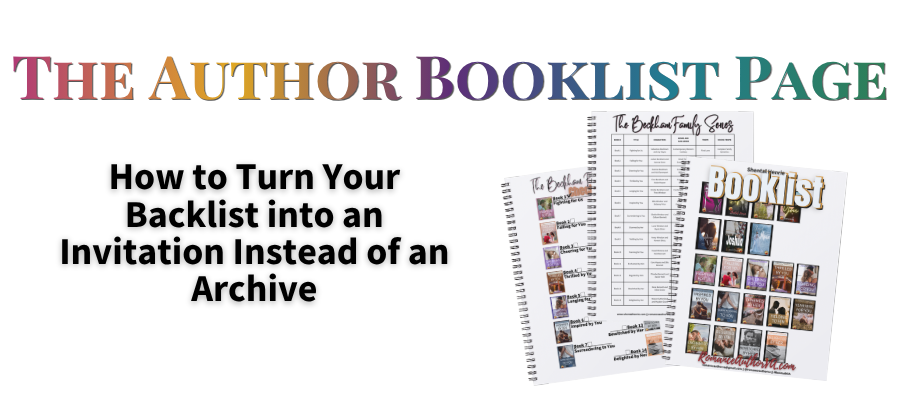
The designed version. Book covers, visual branding, the complete reading order in a format that’s beautiful enough to keep and return to. Gated in exchange for an email address.
The difference between this version and the simple text version is not information — it’s experience. The reader who downloads the designed booklist isn’t solving a problem. She’s choosing to own a piece of the world in a form that’s more beautiful than the functional version she could have gotten for free.
This is the desire-led magnet. She already found the reading order. She downloads this because she wants the beautiful version — because having your book covers, the visual identity of your storyworld, the complete designed document makes her feel more ownership over the world she loves.
The exchange — email address for the designed version — isn’t transactional in the buyer-psychology sense. It’s relational. She’s giving her email because she wants to stay connected to a world she’s already chosen to invest in. The email address is a declaration of belonging, not a transaction.
This version goes into the BFF Funnel Starter Pack as one of the four core templates — a Canva-designed booklist with cover placeholders and series organization built in, ready for any author to customize with her own books and visual identity.
Format 3: The Checklist Booklist (Gated — Email Required)
The most engaging version. Same complete reading order and series information, formatted as a checklist with satisfying boxes to tick off as each book is completed.
The checklist version turns the reading experience into a progress journey. Every book she reads is a box she gets to check. Every unchecked box is a visible reminder of what the world still has to offer. The reader who downloads this and marks off three books in the first week is tracking her relationship with the world in a format that makes the relationship feel concrete and measurable.
This is behavioral design in service of binge reading. The gamification is light — there’s nothing manipulative about a checkbox — but the psychological effect is real. Completion drive activates. The unchecked boxes pull. The reader who might’ve taken a break between Book 3 and Book 4 looks at her checklist and thinks: “I am only halfway through!” She reads Book 4.
This version also functions as a collector’s item for FTM readers. The reader who’s read the entire backlist checks all the boxes and feels something — completion, satisfaction, belonging. The reader who’s just beginning uses it to track progress. Both experiences are served by the same document.
The checklist version is also the most shareable in specific communities. Readers who’re tracking reading challenges, managing their TBR lists, or participating in readathons specifically seek out checklist formats. An author whose series has a checklist is the author whose books get added to challenge lists.
The Funnel Integration — Where This Fits
The three-format booklist answers the NTM reader’s second discovery question — how much of this world exists and how do I navigate it — at three levels of investment.
Ungated simple version: no investment required. Immediate. Solves friction. Maximum reach. Download template now.
Gated cover version: email address. Moderate investment. Desire-led. Signals belonging.
Gated checklist version: email address. Moderate investment. Gamification. Binge activation.
All three are part of the BFF Funnel Starter Pack because the Starter Pack is built specifically to answer all three NTM discovery questions with tools you can customize and deploy immediately. The booklist addresses question two. The cast of characters addresses question one (what kind of world is this, who’re the people in it). The reader magnets address question three (what else exists beyond the books).
Together they constitute a complete NTM orientation suite. And start your free to paid marketing funnel.
The order of deployment: ungated simple version lives permanently on the website with no gate. The gated versions are offered through the email opt-in sequence, through social content that points to the opt-in, and through the reader magnets section of the Reader Experience Hub. The reader who wants the beautiful version or the checklist knows where to go.
The Compound Value of Getting This Right
The booklist page is the second most important page in your ecosystem after the Start Here page — because it’s the page that converts a curious reader into a committed binge reader.
A reader who lands on a well-built booklist page and sees twelve books organized into two series with clear reading order, character names, tropes, and an entry point recommendation doesn’t think: this is too much.
She thinks: there’s so much world here!!!!!!!! She starts at the beginning. She reads the first book. She comes back for the second. The booklist page is the infrastructure that makes the binge possible.
The store map is NOT optional. It’s the mechanism that holds the reader who’s already decided she wants to stay.
The three booklist templates — simple text, cover version, and checklist — are included in the free BFF Funnel Starter Pack, ready to customize with your own books and visual identity.
The complete ecosystem this page lives inside — and how it connects to every other page in your author website — is in the FREE Reader-First Author Platform Guide.