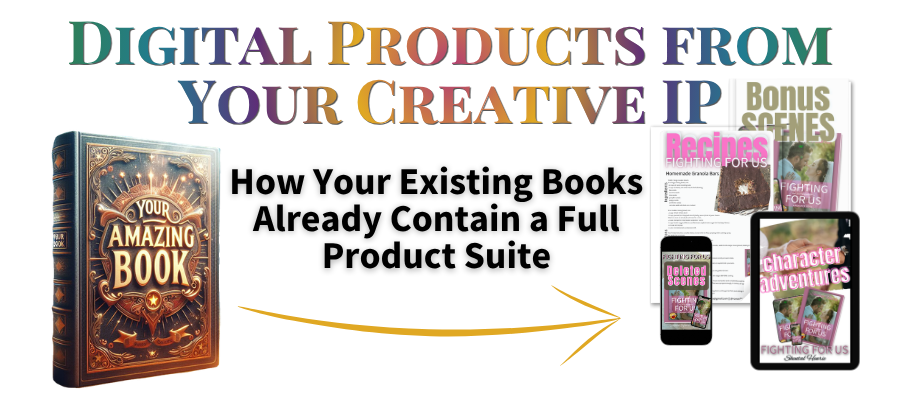
Romance authors are sitting on product suites they can’t see.
Not because the products don’t exist. Because nobody showed them where to look.
The characters you already built, the world you already designed, the scenes you cut from the final manuscript, the backstories you know intimately but never published, the timeline you sketched in your notebook while plotting the third book — all of it is revenue-ready creative IP.
Not someday, not after you build something new. Right now, from everything you’ve already written.
The secondary income principle at the heart of the BFF Strategy says this plainly: the BFF Strategy teaches romance authors that their existing creative IP is the raw material for a complete digital product suite. This is not a side hustle added on top of the book business. It’s the book business fully realized — a model where serving readers well is the revenue model, because readers who are genuinely served stay, buy, and bring other readers with them.
Why This Matters Differently for Romance Authors
Every genre has readers who want to go deeper into stories they love. But romance readers are in a category of their own when it comes to the depth of emotional investment they form with the worlds they inhabit.
A romance reader who loves your MMC doesn’t just want to read his story. She wants to understand him. She wants to know what he was thinking in the scene where he almost said it. She wants the alternate POV that shows his perspective of the moment she didn’t expect. She wants the backstory the book couldn’t hold without losing pace. She wants the deleted scene that showed his vulnerability before he learned to hide it again.
None of that requires you to write a new book. Every single one of those products lives inside the book you already wrote — in the scenes you cut, the backstory notes you kept, the character research you did that never made it to the page, and the creative decisions you made before you started drafting.
The product suite is already there. It just hasn’t been packaged yet.
The Six Product Categories Inside Every Storyworld
Every romance series contains source material for six product categories. You don’t need all six immediately. But knowing they exist changes how you look at your creative IP — and how much of what you thought was just “writing notes” is actually a product waiting to be built.
Characters — Your Highest-Value Asset
Characters are where reader attachment is deepest, which makes character-based products your most emotionally powerful and most reliably converting product category.
What lives here: character dossiers that go deeper than the book, alternate POV scenes from the MMC’s perspective, character backstory documents that explain the wounds he carried before he met her, character interview extras, dual character profiles for the main couple that map their emotional arcs through the story, cast of characters guides for the full series, and character relationship maps showing how everyone in the universe is connected.
The community map from your story notes is a character product.
The deleted scene where the hero’s walls started to crack is a character product.
The character backstory you know completely but never put on the page is a character product.
Every one of these began as writing prep. Every one of them is something a deeply attached reader will pay to experience.
World Building — Your Setting as Immersive Product
Your setting isn’t just where the story happens. It’s an emotional environment readers want to inhabit — and it contains far more product material than most authors realize.
What lives here: community maps of your fictional town or setting, location guides showing where key scenes happened and what each place means emotionally, the history of the world that preceded the story, the rules of the world (for fantasy and paranormal romance), seasonal atmospheres with sensory details from your notes, the aesthetic and visual language of your world packaged as mood boards or look books.
A romance reader who loves a small-town series doesn’t just love the couple. She loves the town. She wants to walk those streets. She wants to know which diner the characters go to and what the blind curve on the road out of town looked like before it was repaved.
That level of world-attachment is what turns a setting into a product category.
Story Elements — The Architecture of the Narrative
The structure of your story contains product material that most authors leave completely untouched because it feels too “behind the scenes.” Romance readers don’t experience it that way. They experience it as insider access — exactly the kind of thing a superfan pays for.
What lives here: reading order guides and universe timelines, story outlines showing how the emotional arc was built, the research that shaped the world and the characters’ behavior, events timelines showing what happened when across the series, pronunciation guides and glossaries for complex universes, trope deep dives exploring what makes your specific version of the trope different from every other enemies-to-lovers story ever written.
The story outline you used to draft the book feels like a writing document to you. To a reader who’s finished the series and wants to understand how the emotional arc was engineered, it’s a product she’d pay $12 for without hesitation.
Extras and Bonus Content — What Didn’t Make It to the Page
This is the most direct translation from writing notes to product. Everything you created for the story that didn’t end up in the final manuscript is already a product — it just needs packaging.
What lives here: deleted scenes (with a note explaining why they were cut and what the reader learns from them), alternate endings, scenes from secondary characters’ perspectives, the moment that happened off-page between books, the epilogue set six months after the HEA, the chapter that was almost in the book but changed the pacing.
Every deleted scene you have is a product. Every moment you know happened but chose not to narrate directly is a product.
Every “what happened between books” question readers ask you in comments is a product answer waiting to be packaged.
Bundles — Cohesion Across the Product Suite
Individual products serve readers at specific moments. Bundles serve readers who want everything, at the depth of investment that reflects how attached they are.
What lives here: a one-book bundle (character dossier, deleted scenes, and reading order for one specific book), a series survival kit (everything a reader needs to binge the full series without missing anything), a character bundle for the main couple across all 14 books, a world bundle that packages the community map, the location guide, and the seasonal atmosphere into one complete storyworld experience.
Bundles are also the home of your mid-ticket and high-ticket products. A $5 character profile and a $9 deleted scenes collection become a $22 “everything about this couple” bundle.
The source material is the same. The packaging produces the value escalation.
Premium and Tailored Experiences — For Your Most Attached Readers
At the top of the product ladder are products that exist because reader attachment at this level is specific, deep, and willing to invest accordingly.
What lives here: a fully designed poster-quality community map of your world, a complete series companion guide covering every book with artwork and full-color design, a character calendar featuring your main characters, a personalized workbook where a reader works through a real-life problem alongside her book boyfriend, a bespoke reading guide built around her favorite couple.
These products require more design investment and are priced accordingly. They serve the reader who’s already moved through every other layer and is still looking for more world.
She exists in every romance audience. And when you build for her specifically, she doesn’t just buy — she tells everyone.
What to Build First
The question isn’t which of these six categories is most valuable. Every one of them serves a different reader at a different stage of attachment. The question is which one matches where your readers currently are and what you can build right now from material you already have.
If you have readers who consistently ask about your characters — who the MMC really is, what he was thinking, what happened in the scene before the first chapter — your first product is a character extra. It already exists in your notes. You’re packaging what’s there.
If readers keep asking about reading order or which book to start with — your first product is a navigation tool. It already exists in the structure of your series. You’re organizing what’s there.
If you have deleted scenes sitting in a document on your computer — your first product is right there. Add a short introduction explaining why the scene was cut and what the reader learns from it. Package it. Price it at $1.99. It was already written. You’re publishing what’s there.
The creative work is done. The product work is packaging.
The Connection Back to the Full System
Digital products from your creative IP connect directly to both the product ladder and the tiered library system — because those systems describe how the same material is priced and formatted across three tiers, not three different ideas.
The deleted scene that lives in your writing folder becomes an Open Shelf excerpt teased publicly, a Lending Library download given to email subscribers, and a Special Collection premium edition sold in your shop. One piece of source material.
Three products. Three tiers of reader attachment served.
The character dossier you built during drafting becomes a low-ticket, high-valued $7 download for readers who’ve just finished the book and want more of him, a mid-ticket $15 extended bundle for readers who want his full series arc, and a high-ticket $37 couple’s complete collection for the superfan who’s read everything and wants to own the definitive portrait of this relationship.
Every piece of creative IP you built when you wrote your books maps somewhere on this grid. The product suite is already there. You’re not building something new. You’re revealing what’s been there all along.
Where to Go Deeper
The reader-first monetization model — why romance readers are the most natural buyers in publishing when the ecosystem is built to serve them — is here:
→ The Reader-First Monetization Model
The four pricing tiers and the psychology behind how reader attachment drives each one:
→ The Romance Author Paid Product Ladder
And for the complete product suite architecture inside one comprehensive system:
Shental Henrie is a 30+ year romance reader who has read 3,000+ romance novels and is the creator of the BFF Strategy™ — the first reader-first ecosystem framework for romance authors, built from inside the reading experience.