Most romance author websites are a collection of pages that happen to share a domain name.
There’s a home page. A books page. An about page. Maybe a blog. A contact form somewhere. Each one was built at a different time, with a different purpose in mind, and none of them were designed to work together. A reader who arrives at one has no clear path to the others. A reader who finishes one doesn’t know where she’s supposed to go next. The site exists, but it doesn’t function.
A genuine ecosystem works differently. Every page has one specific job. Every reader has a clear path from her entry point to wherever she needs to go next based on where she is in her relationship with your world. And the same emotional language — the Semantic Fingerprint of your storyworld — runs through every page simultaneously, telling every algorithm and every reader exactly what your world is, who it’s for, and what it delivers.
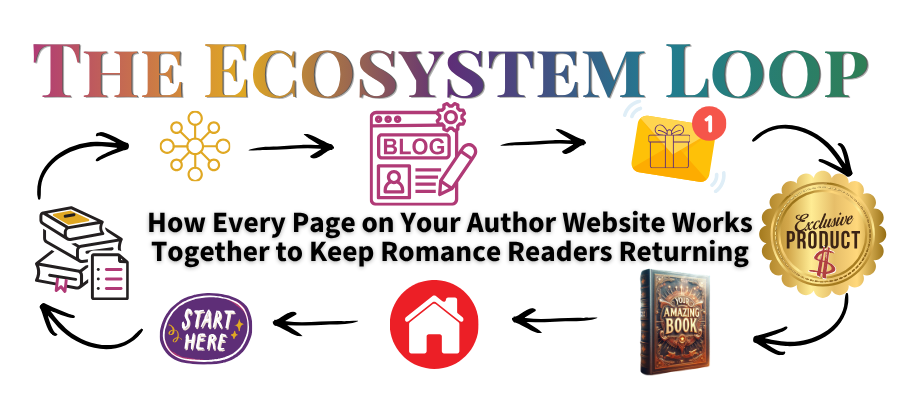
This is the Ecosystem Loop. Here’s the complete map.
The Six Pages and Their Jobs
Your author website ecosystem has six pages that work together as one connected system. Each has a non-interchangeable role. Remove one and the system has a gap. Build all six correctly and a reader can enter at any point and find her way through the entire world.
The Home Page is the front door and first impression. Its job is to answer the emotional promise question in the first three seconds: does this world feel like it could be mine?
It doesn’t sell. It orients.
The Semantic Fingerprint’s Chemistry layer — the atmospheric, sensory, vibe signals that belong to your storyworld — carries more weight here than anywhere else, because a reader deciding whether to stay is responding to atmosphere before she reads a word of description.
The Start Here Page is the welcome desk. Its job is to orient every reader — new or returning — and give her a clear, specific next step based on where she is in her journey with your world.
This page exists specifically because readers arrive at your ecosystem from dozens of different entry points (social posts, search results, recommendations, AI suggestions) and have no natural shared starting point. The Start Here page gives them one. It serves the NTM reader and the FTM reader simultaneously through a three-path structure.
The Author Booklist Page is the series map. Its job is to show every reader the complete scope of your storyworld and make the binge feel possible and organized. Reading order, series groupings, standalone guidance, series connections — everything a reader needs to commit to your world fully rather than tentatively.
The Reader Experience Hub is the immersive storyworld space. Its job is to give every reader more world beyond the books — the place she goes when a book ends and she isn’t ready to leave.
Character extras, world maps, deleted scenes, atmospheric content, behind-the-scenes material. This is where NTM readers become FTM readers and where FTM readers find reasons to stay between releases.
The Author Blog is the compound authority engine. Its job is to build the permanent, keyword-anchored asset base that earns citations over time and feeds every other page in the ecosystem with traffic. It is the source document for social content, email content, and everything that compels search engines and AI tools to recommend you.
The Individual Book and Series Pages are the conversion points. Their job is to give each book its own complete, searchable, emotional presence — a full Semantic Fingerprint applied specifically to that book and that series, so readers who’re searching for exactly what this book delivers can find it directly.
The Author Shop — Where Emotional Attachment Becomes Owned-Platform Revenue
There’s a seventh page in an author’s ecosystem, and it’s the one that turns this loop into a business.
The Author Shop page is where a reader who loves your storyworld can invest in it beyond buying your books.
Character dossiers.
Series companion guides.
Premium world maps.
Digital products built from the creative IP already inside your storyworld.
The shop is NOT an add-on to the ecosystem — it’s the destination the ecosystem naturally moves a deeply attached reader toward.
The critical distinction: your shop lives on your domain. Not on Amazon. Not on Etsy. Not on Gumroad or Payhip as a standalone storefront. On your website, integrated into your ecosystem, so that every purchase strengthens your owned platform and every buyer’s email address belongs to you.
When a reader buys your $7 character dossier through Amazon, Amazon owns the transaction and the data. You receive royalties.
When she buys it through your own shop, you receive the full revenue, you own her purchase history, and you can reach her directly with everything you create next.
The shop in the ecosystem loop:
Where it connects: The shop is linked from the Hub (where deeply attached readers find premium extras), from individual book pages (where recently converted readers see that more of the world exists), and from the email nurture sequence (where you introduce paid products to readers who have already been through the welcome sequence). It’s not prominently featured on the Start Here page — she needs to be oriented and attached before the shop is relevant.
What belongs in it: Products built from your existing creative IP — not books, not generic merchandise that could belong to any author, but storyworld-specific assets that only have value to readers who love this specific world. Character bundles, world companion guides, premium digital extras, and eventually collectible physical products for the deepest layer of superfan investment.
The Semantic Fingerprint in the shop: Each product page carries the Structure and Heart keywords specific to the characters and world it features. A shop page for a Sebastian Beckham character bundle includes the book’s trope language, the series name, and the emotional experience language in its description — making the product findable by readers who are specifically searching for more of this world.
The shop’s existence signals something important to every reader who encounters it: this world is deep enough to warrant an entire product suite. That signal deepens attachment even for readers who don’t buy anything. The awareness that more exists makes the world feel more substantial.
The Supporting Pages — What They Do and Why They’re Built Wrong on Most Author Websites
Every romance author website also has three supporting pages that most authors build incorrectly — not because they’re unintelligent, but because they’ve been taught to build them for the author’s needs rather than the reader’s.
The About Page
Most about pages tell the author’s story: where she grew up, when she started writing, what her pets are named, her publication journey. This information may be interesting to someone who already loves the author. It’s NOT what a new reader needs from an about page.
A reader-first about page has one job: confirm to a curious reader that this author is worth trusting with her emotional investment. It answers: who built this world, why did she build it, and why should I believe she understands what I want as a reader?
The credential that belongs front and center on the about page is the one that earns reader trust: the reading credential.
For the BFF Strategy this is “30 years, 3,000+ novels, built from inside the reading experience” — but every romance author has a version of this. How long she’s been a romance reader. What the genre means to her as a reader, not just as a writer. The specific emotional territory she writes in and why she writes there.
The about page closes with a connection invitation — not a sales pitch, but a clear next step. “Start with Book 1 of the Beckham series” or “Find your entry point on the Start Here page.” The about page is often where a curious reader lands after Stage 2 Curiosity — she wants to know if this author can be trusted before she commits. Give her the answer and then give her somewhere to go.
The Semantic Fingerprint on the about page: Heart keywords throughout. The author’s voice and the reader’s emotional experience intertwined. The branded Level 9 terms paired with searchable Level 7-8 language — “the BFF Strategy — the reader-first romance author marketing system built by a 30-year romance reader” rather than “the BFF Strategy” alone.
The Media Kit
The media kit is the press pack behind the counter — not a page most readers ever see, but a page that matters enormously when someone wants to feature you, interview you, include you in a newsletter, or recommend you to their audience.
It belongs on your website, not as a public navigation item but as a findable page you can link to when someone asks.
It contains: a short author bio in two or three versions (one sentence, one paragraph, full), your headshot in downloadable format, your book covers in downloadable format, your contact email for media inquiries, and links to your most relevant published articles or interviews.
The job of the media kit is to make saying yes to featuring you frictionless. A blogger who wants to recommend your books to her audience but can’t find your bio or cover images in usable formats will feature someone else. The media kit removes that obstacle.
The Contact Page
The contact page is the ask-the-bookseller bell. It should be simple, warm, and specific about what kinds of contact you welcome. A reader who wants to send a message. A blogger who wants to interview you. A podcast host. Another author interested in a newsletter swap. A reader with a question about the reading order.
It should not be a form with fifteen fields asking for the person’s organization, the nature of their inquiry, and their preferred response time. One email address or one simple form with a message field. The warmth of your brand voice applied to a single sentence of invitation.
The contact page is not a lead-generation tool. It’s a welcome signal — proof that there’s a real person behind the ecosystem who can be reached. That signal matters to readers and to collaborators alike.
How the Loop Works
The ecosystem loop is the pathway a reader travels when your site is built correctly. She enters at any page — she might arrive at a blog post from a Google search, or at a book page from an AI recommendation, or at the Hub from a social post — and the loop keeps her moving rather than stopping.
Every page has one job and one clear next step built into it:
1️⃣ Home → 2️⃣ Start Here (orient her)
1️⃣ Start Here → 2️⃣ Booklist or Reader Hub (based on which path she’s on)
1️⃣ Booklist → 2️⃣ Individual book pages → 3️⃣ Hub (deepen after she chooses a book)
1️⃣ Reader Hub → 2️⃣ Booklist or email signup (give her more and invite her in) → 3️⃣ Shop (purchases extras)
1️⃣ Author Blog → 2️⃣ Reader Hub or Booklist or book pages (send the traffic somewhere useful)
1️⃣ Individual book page → 2️⃣ series page → 3️⃣ Hub or email → 4️⃣ next book
1️⃣ Reader Hub → 2️⃣ Individual book pages → 3️⃣ Hub (deepen after she chooses a book) → 4️⃣ Shop (purchases an extra that deepens the user experience of storyworld)
The loop doesn’t have dead ends. Every page points somewhere. Every reader, regardless of where she entered, can find her way to the full world you built.
The loop breaks when:
A page is missing (no Hub means no post-book immersion space)
A page doesn’t point anywhere (no internal links)
The language is inconsistent (the Semantic Fingerprint shifts from page to page)
The Semantic Fingerprint Across the Ecosystem
The Semantic Fingerprint — the three-pillar combination of Structure, Chemistry, and Heart keywords that belongs to your storyworld — runs through every page. But it shows up differently depending on each page’s job.
Home Page: Chemistry layer leads. The atmospheric signals, the vibe language, the sensory descriptors. This is the first impression and it has to feel right before it has to be right.
Start Here Page: Heart layer leads. The emotional promises and identity signals that help a reader say “yes, this is for someone like me.” The Level 7 and 8 language that names her state and offers her the path forward.
Author Booklist Page: Structure layer leads. Genre, subgenre, series names, reading order signals. This is the navigational page — it needs to be clear and correctly labeled before it needs to be atmospheric.
Reader Experience Hub: Chemistry and Heart layers together. The world’s atmospheric identity running alongside the emotional promise of what it delivers. The place where the reader who already loves your world finds more of exactly what she came for.
Author Blog: All three layers, deployed systematically. Structure keywords in titles and slugs, Chemistry keywords in body copy and captions, Heart keywords in opening sentences and subheadings. The blog is where the full Semantic Fingerprint earns compound authority.
Individual Book Pages: Full Semantic Fingerprint deployed per book. Each book gets its own structure, chemistry, and heart signals — not shared with every other book, not averaged across the backlist. One book, one complete fingerprint.
The Online Shop Page: Structure and Heart keywords specific to the characters and world it features. Each product gets its own structure and heart signals making each product findable by readers who’re specifically looking to deepen their emotional experience of your storyworld.
Where to Go Deeper
Each page in this ecosystem has its own dedicated article this week. Every one goes into full detail on what the page contains, what the Semantic Fingerprint looks like on that specific page, and how to build it:
→ The Start Here Page: The Welcome Desk Your Author Ecosystem Needs
→ Why Every Romance Author Needs a Dedicated Booklist Page – and How to Build One that Actually Works for Readers
→ The Reader Experience Hub: Where NTM Readers Become FTM Readers
→ The Author Blog as Compound Asset: Why This One Platform Never Expires
→ Individual Book Pages and Series Pages: The Most Underbuilt Pages in Romance Author Marketing
→ The Author Shop: Why Your Online Store Should Live on Your Website, Not Someone Else’s Platform
→ Social Media’s One Job: Why the Hallway Exists and What It Should Never Try to Be
The BFF Playbook covers the complete ecosystem architecture with implementation detail for every page:
→ BFF Playbook → ($97)
Get the FREE Reader-First Author Platform Guide that shows you how to build the kind of author platform so that when readers arrive, they find a world designed for them — not a brochure designed for you. Free when you sign up!
Shental Henrie is a 30+ year romance reader who has read 3,000+ romance novels and is the creator of the BFF Strategy™.


