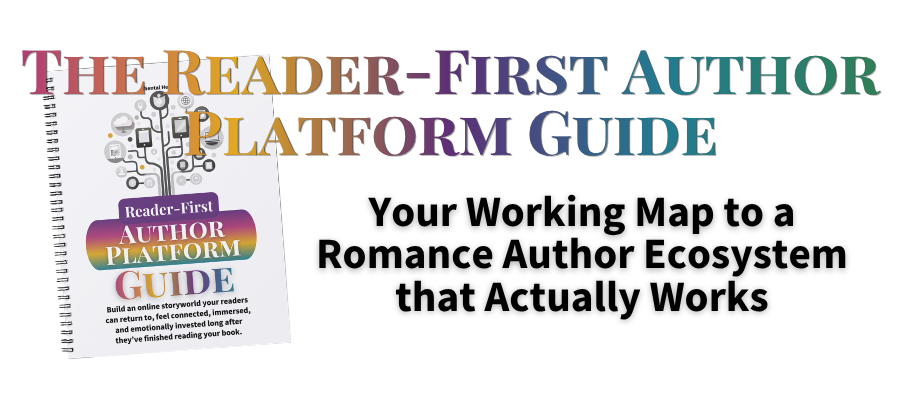
You don’t need another course on what platforms to use. You need a clear reference document that tells you what every piece of your online presence is for — and what to build first. That’s what this guide is.
Here’s the problem with most author platform advice.
It tells you what tools to use. MailerLite for email, Canva for graphics, BookFunnel for magnet delivery, Linktree for your bio link. The tools are fine. The tools are not the problem.
The problem is that nobody tells you how the tools connect. What goes where. What each piece is supposed to do. Why you have a website and a social presence and an email list and a reader magnet and why none of them are talking to each other.
The Reader-First Author Platform Guide isn’t a course on tools. It’s a map.
Specifically, it’s the map of the complete BFF Strategy ecosystem — every element named, every element’s job described, every element’s relationship to the other elements made clear — so that you can look at any piece of your current platform and know immediately whether it is in the right place doing the right job.
What’s Inside the Guide
The guide walks through the complete Library Analogy ecosystem — the teaching framework at the heart of Module 2 of BFF University. If you have not yet read the full Library Analogy breakdown, that article is here. The guide is the portable, printable companion to that lesson.
Here’s what every section covers:
The Mainland Library and How It Works
What the algorithm actually is, how it decides where to shelve you, and what you can do to make sure your books end up in front of the right reader rather than the unsorted pile in the basement. This section introduces SEO, AEO, and GEO in plain language — not as technical concepts but as three different helpers who each speak to a different kind of reader search.
The Hallway (Social Media)
What social media is actually for — and what it is not for. Its one job. Why trying to make it do more than that job produces exhaustion without compounding. What to post in the hallway and what to save for the bookstore.
Your Author Website — Room by Room
This is the core section of the guide. Every page of your website described with its job, what it must contain, and what makes it work for both your NTM and FTM readers. The home page. The Start Here page. The booklist page. The Reader Experience Hub. The book pages. The shop. The blog. Nothing assumed. Every room mapped.
The Island Libraries (Amazon and Retail)
The honest breakdown of what Amazon and other retailers can and cannot do for you. Why they are distribution channels, not your platform. How to use them strategically without building on their foundation.
Your Email List and Welcome Sequence
Why the email list is the most valuable asset in your ecosystem, what the first email after a download must do, and the shape of a welcome sequence that builds genuine reader relationships rather than automated broadcasts.
Your Reader Magnets
What a reader magnet is actually for, why most of them don’t work, and the three questions every magnet must answer for the reader who downloads it.
The Build Sequence
What to build first, what to build second, and why the order matters. This section alone prevents the most common platform-building mistake — starting with social media before the owned infrastructure exists to receive the readers it sends.
Who this Guide Is For
This guide is for the romance author who has some platform pieces in place but feels like nothing is connecting. She has a website and a social presence and probably an email list, but they don’t feel like a system — they feel like separate things she maintains separately with separate effort.
It’s also for the romance author who’s starting from scratch and wants to understand the full picture before she builds anything, so she builds in the right order rather than having to rebuild later.
It’s not a beginner’s guide to the internet. It assumes you know what a website is and what social media is. What it gives you is the strategic framework for understanding why those things exist in the context of your specific goal: building a reader-first romance author ecosystem that brings the right reader to your world and gives her a reason to stay.
How to Use this Guide
Print it. Keep it beside you when you’re making platform decisions.
When you’re wondering whether you need a Linktree or a Start Here page, the guide tells you. When you’re trying to decide what to put on your home page versus your booklist page, the guide maps it. When you’re building your first reader magnet and can’t figure out where to put it, the guide shows you the five entry points.
It is a reference document, not a course. Use it the way you’d use a building blueprint — not to read once and set aside, but to refer back to constantly as the ecosystem comes together.
The Free Download
The Reader-First Author Platform Guide is free.
→ Sign up here to get the FREE Reader-First Author Platform Guide!
Once you have the guide, the next step is understanding how to build your online ecosystem. Learn how Your Romance Books Built a Storyworld. Here’s How to Build the Ecosystem Around It.
Or Welcome to the Library: A Romance Author’s Complete Map to the Online Ecosystem
Go back to the BFF University — which walks through each element of the Reader-First Ecosystem and learn how to set up your own ecosystem.