Most romance authors approach reader magnets the same way they approach a blank page: staring at it, waiting for an idea to appear.
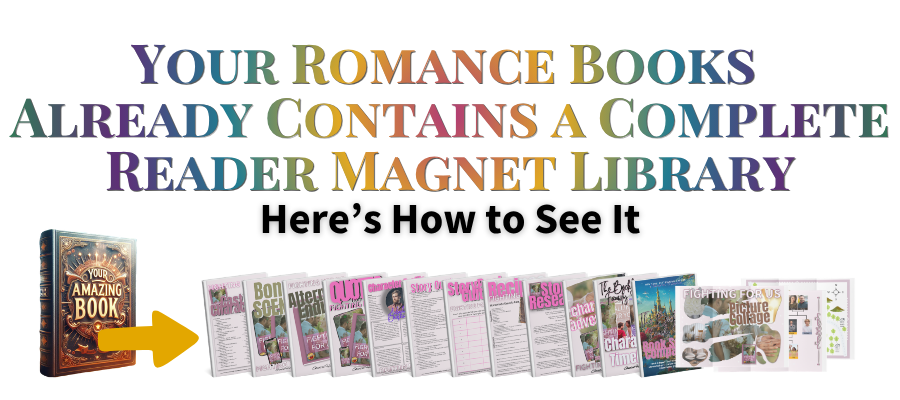
The magnet isn’t something you invent from nothing. It’s something you excavate from something you already have. Every book you’ve written contains a complete library of magnet material — organized by the same angles that organized the writing itself. Characters. World. Story. Series. Behind the scenes.
The problem isn’t a lack of ideas. It’s that most authors don’t know how to look at their existing creative work and see the magnet inventory it contains. They look at their books and see finished products. The BFF Strategy looks at the same books and sees source material.
This article is the complete inventory. Every angle your storyworld gives you, the specific magnet types each angle produces, and where each one lives in your ecosystem. You don’t need to build everything at once. You need to understand what exists so you can choose what to build first.
The Five Angles of Your Reader Magnet Library
Every reader magnet a romance author creates comes from one of five story angles. These angles aren’t invented for the purpose of content creation — they’re the natural architecture of every romance novel.
You already have all five. The magnet library is built by excavating each one.
Angle 1 — Characters
Character magnets are the highest-attachment magnet category in romance because romance readers attach to characters before they attach to anything else. A reader who loves your MMC will sign up for more of him before she’s finished forming the conscious decision to do so.
Character magnets serve two emotional functions simultaneously:
👉 they create a felt introduction for NTM readers who’re deciding whether this world is worth their time, and
👉 they deepen attachment for FTM readers who already love your characters.
What the character angle produces:
Character Dossier — the complete profile: physical description, backstory, wound, what he does for a living, how he speaks, what he can’t say out loud, what readers won’t know until they’ve read the book. Not a Wikipedia entry — a portrait. This is the magnet that makes readers feel like they know him before they’ve read a word of the story.
Dual Character Profile — the main couple together: their individual profiles plus the specific dynamic between them. What she notices about him. What he protects her from knowing. The thing they both want and neither will name. For readers who love the relationship as the unit, the dual profile is more compelling than either character alone.
Character Relationship Map — the full cast of a book or series, organized by their relationships to each other and to the main couple. Who is connected to whom, how, and why it matters. For ensemble-cast series, this is one of the most frequently requested extras.
Character Timeline — what happened to the main character(s) before the story started. The wound, the history, the decisions that shaped who he is when she meets him. The backstory that the book implies but never fully tells.
Character Interview or Q&A — written in the character’s voice, answering questions readers would ask if they could. This is a personality showcase as much as an information document. The voice has to be right for it to work — but when it is, readers experience the character directly rather than through narration.
Character Aesthetic or Mood Board — the visual representation of who this character is: the images, the color palette, the atmosphere that belongs to him. For readers who think visually, this is often more emotionally resonant than text-based magnets.
Character Playlist — the music that belongs to this character’s world, his emotional arc, or the relationship. One of the most personal and immersive magnets because music activates emotional memory independently of text.
Angle 2 — World
World magnets serve readers who aren’t just attached to the characters — they’re attached to the place. Small-town romance readers love the town. Fantasy romance readers love the world. Western romance readers love the ranch and the landscape and the specific texture of the community. World magnets give readers more of the physical and emotional environment that made the story feel like home.
What the world angle produces:
Community Map — the geography of your fictional world: the town, the ranch, the estate, the city neighborhood, the fantasy kingdom. Where significant scenes happened. What each location means emotionally. Available at three levels of depth: a small web-optimized graphic for the Hub (ungated), a printable detailed version for email signup, a poster-size version for the shop.
Location Guide — individual significant locations described in atmospheric detail: the diner where everyone knows too much, the barn where the fight happened, the road that appears in every book. For readers who want to inhabit the world more fully than any single scene allows.
World Timeline — the history of the world or community before the story started. What happened to this town, family, or community in the years leading up to the series. For series with deep history threads, this is the magnet that rewards attentive readers and helps new readers understand what they’re entering.
World Glossary or Pronunciation Guide — for series with invented terminology, titles, or character names that readers consistently struggle with. This is a friction-removal magnet: it doesn’t deliver more world, it removes the obstacle between the reader and more world. Especially valuable for fantasy romance and paranormal romance.
Seasonal Atmosphere Pack — the sensory and emotional experience of your world in a specific season. What autumn feels like in Harlow Creek. What the ranch looks like in the first snow. Atmospheric content for readers who fell in love with the way your world feels, not just what happens in it.
Angle 3 — Story
Story magnets give readers access to the narrative at a level the published book doesn’t provide. They’re the “MORE” that FTM readers are looking for after they’ve finished the book — and they’re a powerful conversion tool for NTM readers who want to see how the story is built before they commit to reading it.
What the story angle produces:
Deleted Scene — a scene that existed during drafting but didn’t make it into the published book. The most effective deleted scene magnets include a brief introduction explaining what the scene is, when it was written, and why it was cut — because that context turns a removed scene into a story-behind-the-story experience. Readers don’t just get content; they get insight into the creative process.
Alternate POV Scene — a key scene from the book rewritten from the other main character’s perspective. A scene the reader experienced through her eyes, now experienced through his. This is the magnet that rewards the reader who wondered “but what was he thinking?” — and it converts reliably because that question appears in reader communities constantly.
Extended Epilogue or Bonus Chapter — what happens after the HEA. Six months later. One year later. The moment the reader wanted one more chapter to see. This magnet serves the FTM reader who finished the book satisfied but not ready to leave the couple.
The Almost Scene — the scene that almost ended differently, or the moment where the story almost went another direction. Written as an alternate version rather than a deleted one. For readers who wanted to see “what if” played out.
Reading Order Guide — the complete reading sequence for a series, with brief descriptions of each book and guidance on whether they read as standalones. This is a friction-removal magnet: it doesn’t deliver more world, it removes the obstacle between the reader and more of the world she wants. Reading order confusion is one of the top reasons readers don’t binge series.
Story Research Document — the behind-the-scenes research that shaped a specific story element. The real psychology term that became the character’s wound. The historical detail that changed the setting. The actual place that became the fictional one. This is story-behind-the-story content at its most specific and most authentic — impossible to replicate because it comes from the real creative history of the book.
Angle 4 — Series
Series magnets serve the reader who has committed to a world — or is deciding whether to. They’re bigger than any single book and require more investment to build, but they produce the deepest reader attachment because they speak to the reader’s relationship with the entire world, not just one story.
What the series angle produces:
Universe Timeline — every significant event across all books, organized chronologically. For series with interconnected storylines and recurring characters, this is the magnet that rewards readers who are following every thread and helps new readers understand the scope of what they’re entering.
Series Family Tree or Connection Map — how every character in the series connects to every other character. Who is related to whom, who has history with whom, whose story will come next and why. For ensemble-cast series, this is one of the most requested extras and one of the most effective for producing “I have to read all of these” responses.
Backlist Checklist — the complete series in checklist format: covers, titles, brief descriptions, space to check off as she reads. A physical artifact of the reading journey. For binge readers who are in the Discovery State and want to commit to the full world, a well-designed backlist checklist with covers is often the magnet that converts fastest.
Series Survival Guide — the complete reference document for a complex series: character list, timeline, important locations, glossary if applicable, reading order, what to read between books while waiting for new releases. For readers who have committed to a long series and want a companion guide to keep beside them.
The Reader’s Guide — questions for book clubs or personal reflection, organized by book or series. For readers who want to go deeper into the emotional themes and discuss them.
Angle 5 — Behind the Scenes
Behind-the-scenes magnets are the category that gives romance authors the clearest competitive advantage over AI-generated content — because this material exists only because a real human being made specific, un-replicable creative decisions. No AI can generate the story behind your story. No AI knows why you almost deleted the scene that became readers’ favorite. No AI can write the real place that became the fictional one. This is the authenticity layer.
What the behind-the-scenes angle produces:
The Story Behind the Story — a narrative document explaining the origin of a specific book: where the idea came from, what the research uncovered, what changed during drafting, what you wanted readers to feel that you hoped they’d find. This is reader-magnet territory and blog content territory simultaneously — a short version makes an excellent magnet, a long version makes an excellent article.
Author’s Note or Letter to the Reader — a personal note explaining what this story meant to you to write, what you hoped readers would find in it, and what you want them to know before or after they read it. For readers who form strong parasocial attachments to authors they love, this is one of the most intimate and valued extras.
The Writing Process Document — how this specific book was written: where you wrote it, what you listened to, how long it took, what was hard, what surprised you. For readers who are also writers, this is particularly compelling. For readers who aren’t writers, it makes the author feel more real.
Inspiration Board or Visual Reference Pack — the images, real places, aesthetic references, and visual material that shaped the world or the characters during writing. What he looks like in your head. The real landscape that became the fictional one. The photographs that made the setting feel real while you were writing it.
How the Library Grows Over Time
You don’t build the whole library at once. You build it in layers, starting with the magnets that match where your readers currently are in their journey with your world.
If you’re launching your first book: start with the character angle. One character dossier, one dual profile, one reading order guide (even for a single book — “start here” is a complete reading order). These three magnets answer the three NTM discovery questions and give a new reader the orientation she needs.
If you have one completed series: add the series angle. The universe timeline, the connection map, the backlist checklist. These serve the readers who have committed to your world and want more of it between releases.
If you have a backlist and an established readership: the behind-the-scenes angle becomes your most powerful category, because it produces the authentic, unreplicable content that deepens attachment in ways no plot-based magnet can match.
The library grows with your storyworld. Every new book adds new character magnets, new world extras, new story behind-the-story material. The supply is effectively unlimited — not because you’re inventing content, but because the world you’re building keeps generating it.
Where the Magnet Library Lives in Your Ecosystem
The library as a collection belongs in three places.
The ungated top of the library — the Open Shelf — lives in your Reader Experience Hub. The small community map, the character card, the atmospheric excerpt. Available to any reader who arrives, with no barrier, showing that your world extends beyond the books before she’s been asked to invest anything.
The gated middle of the library — the Lending Library — lives in your welcome sequence. The detailed dossier, the full deleted scene, the complete universe timeline. Delivered after she signs up, this layer deepens the relationship that began with the free content.
The paid bottom of the library — the Special Collection — lives in your author shop. The premium versions: the designed dossier bundle, the full-series companion guide, the poster-format map. For readers who want to own more of the world at the highest level of depth and design.
The same magnets, organized by depth and investment level, serve readers at every stage of their attachment to your world. The library is the inventory. The tiered structure is the deployment.
Where to Go Deeper
Understanding what’s in the library is the first step. Understanding how to structure the reader’s path through it — from free to paid, in a sequence that honors where she is emotionally — is the second step, and it’s covered in the free-to-paid journey article that pairs with this one. The two articles together give you everything you need to build a reader magnet strategy that serves readers at every stage and generates revenue from the attachment you’ve already built.
The tiered reader magnet library article explains how one single magnet idea scales across three levels of depth and value — that’s different from this article’s breadth inventory, and it’s worth reading alongside this one to understand both dimensions of the library system.
The BFF Playbook covers the complete reader magnet strategy within the full ecosystem architecture, including how the library connects to the welcome sequence, the Hub, the product ladder, and the long-term relationship system.
Shental Henrie is a 30+ year romance reader who has read 3,000+ romance novels and is the creator of the BFF Strategy™ — the first reader-first ecosystem framework for romance authors, built from inside the reading experience.