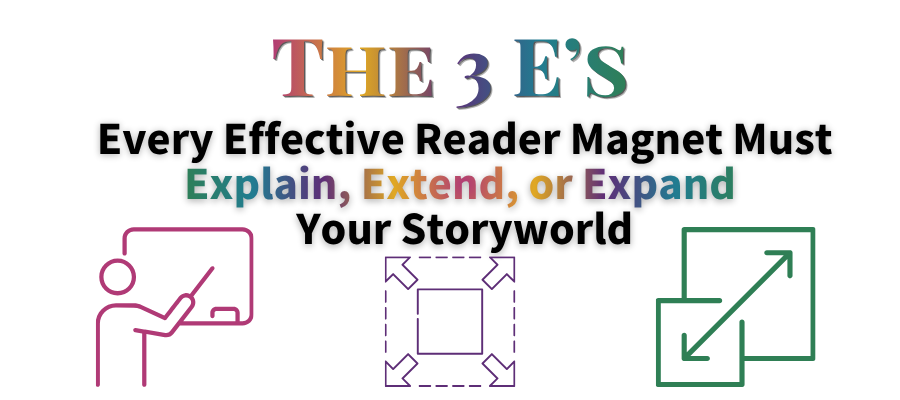
Before you build your next reader magnet, answer one question. Not “what format should I use?” Not “should it be a PDF or a checklist?” Not “how long should it be?” Those questions come later, and they matter much less than you think.
The question is: does this explain, extend, or expand my storyworld in some way that allows readers to experience more?
If the answer is yes — clearly, specifically, unmistakably yes — you have a reader magnet worth building.
If the answer is no, or if you find yourself hedging, the magnet won’t do what you’re hoping it will do. Not because it isn’t well-made. Because it isn’t built on the right foundation.
The 3 E’s are the diagnostic that tells you which situation you’re in before you spend the time finding out the hard way.
Why the Diagnostic Exists
Most reader magnet advice focuses on format: ebooks work, checklists work, PDFs work, templates work. And that’s technically true — all of those formats can work. The format isn’t the problem.
The problem is that a beautifully designed PDF built on a premise that doesn’t ACTUALLY serve a reader’s desire for your storyworld will NOT convert the way you want it to.
A checklist that teaches romance readers something general about romance novels but has nothing to do with your specific characters or world isn’t a reader magnet in the meaningful sense. It’s a freebie. And a freebie produces downloads. A reader magnet produces relationships.
The distinction between a freebie and a reader magnet isn’t design quality or format or length. It’s whether the asset is rooted in your specific storyworld in a way that can only exist because you wrote these books. The 3 E’s test for exactly that.
E #1: Explain
Does this asset explain something about your storyworld that a reader needs in order to navigate it more confidently, more enjoyably, or more completely?
Explanation magnets answer practical questions readers actually have. Not questions in general — questions about your specific world. The reading order that tells her which book to start with and why. The cast of characters list that shows her how everyone is connected. The universe timeline that maps how all 14 books fit together across the same fictional town. The pronunciation guide for the names in your fantasy world. The glossary of world-specific terms that keeps appearing in the text.
These are friction-led magnets — and as covered in the reader magnet psychology article, friction-led magnets work because they serve a desire that already exists. The reader who downloads your reading order guide isn’t doing it because she loves organizational tools. She’s doing it because she already wants to binge your books and can’t figure out where to start. The magnet removes the obstacle between her and more of your world.
The test for Explain: is there a specific practical question a reader of your books genuinely asks? Does this magnet answer it clearly and completely? Is the answer specific to your world — would it be meaningless to a reader who hadn’t read your books or wasn’t planning to?
If yes to all three, it’s an Explain magnet. Build it.
E #2: Extend
Does this asset extend the emotional experience a reader already had inside your books — giving her more of something she loved, beyond what the published pages contained?
Extension magnets are the purest form of reader desire served directly. The reader at midnight, just finished the last page, not ready to leave. She doesn’t want information. She doesn’t want orientation. She wants MORE. More of that character. More of that relationship. More time inside the emotional atmosphere that she just lived in for the past however many hours.
Extension magnets deliver exactly that: a deleted scene that shows a moment that happened off the page. An alternate POV scene from the MMC’s perspective. An epilogue set six months after the HEA. A scene from a secondary character’s backstory that explains why she is the way she is. A bonus chapter that answers the question readers always ask at the end.
These are desire-led magnets in their purest form. No obstacle to remove. No practical need to serve. Just MORE storyworld, delivered to a reader who loved the world and wants to stay inside it a little longer.
The test for Extend: is there something in your story that already exists — a character, a moment, a relationship, a scene — that readers consistently want more of? Does this magnet deliver more of that specific thing in a way that is only possible because you wrote these books?
If yes, it’s an Extend magnet. Build it.
E #3: Expand
Does this asset expand the reader’s understanding or experience of your storyworld beyond what any single book contains — showing her the full shape and depth of the world she’s fallen into?
Expansion magnets serve a specific reader state: the one who has become invested enough in your world to want to understand its full architecture. She’s not just curious about the couple in the book she read — she wants to know how they fit into the larger universe. She wants to see the timeline that spans all 14 books. She wants the community map that shows where every significant scene happened. She wants the world-building document that explains the rules of the magic system. She wants the full cast of characters across the entire series and how everyone is connected.
Expansion magnets are world-building assets made accessible. They take the creative architecture you built in order to write the books and translate it into something a reader can hold and explore. They serve the reader who’s transitioning from casual fan to invested participant in your storyworld — the reader who’s becoming a superfan.
These magnets also work as world-extension magnets for readers who have read everything and want more before the next book releases. A story that happens between books. A character’s backstory that predates the series. A glimpse of what the world looks like in an epilogue set ten years after the final book. Expansion magnets serve both the deepening reader and the waiting reader.
The test for Expand: does this asset show the reader something about your world that goes beyond what any single book reveals? Does it serve the reader who wants to understand the full scope of what you’ve built — or the reader who has read everything and still wants more?
If yes, it’s an Expand magnet. Build it.
What Happens When a Magnet Fails the Test
The most common reason a well-designed reader magnet underperforms is that it doesn’t actually pass the 3 E’s test.
A general “romance reading guide” that teaches readers how to choose books doesn’t explain your world, extend your story, or expand your universe. It’s informational content about romance as a genre. It might be interesting to the right reader, but it doesn’t build a relationship with your world because it isn’t about your world.
A “how to write your own romance” guide is worse — now you’re not only failing the 3 E’s test, you’ve shifted from reader-facing to aspiring-author-facing content. The reader you’re trying to build a relationship with isn’t your audience for that asset.
A seasonal “cozy autumn reading list” featuring other authors’ books doesn’t explain, extend, or expand your storyworld unless your books are prominently featured and the list is explicitly positioned as an entry point into your world. A generic list built to serve the season rather than the reader’s relationship with your books is a content play, not a reader magnet.
The test is not difficult to apply. It just requires honesty about what the asset is actually doing. If you find yourself explaining why the magnet is useful to readers in general, rather than specifically useful to a reader who loves or wants to love your world — run the test again.
Using the 3 E’s to Build Your Full Magnet Suite
Every complete reader magnet suite needs all three types. Not as a menu to pick from. As a complete answer to what different readers need at different stages of their journey with your world.
The reader at Stage 2 — Curiosity — needs Explain and Expand magnets. She’s just discovering your world and needs orientation. The reading order, the cast of characters, the universe overview — these give her the context to go deeper.
The reader at Stage 4 — Immersion — is moving through your books and starting to attach. She needs Extend magnets most. She’s not confused about where to start anymore. She wants more of the world she’s already inside.
The reader at Stage 5 and beyond — Attachment and Conversion — needs Expand magnets that show the full depth and scope of your world. The complete series companion. The full universe timeline. The world-building document. The content that says: this world is bigger and richer than any single book could contain.
A magnet suite with all three types serves every reader regardless of where she is in her journey. Each magnet has a specific job. Each one deepens the relationship she’s building with your world. And each one connects naturally to the next stage of the flow — from magnet to welcome sequence to Hub to booklist to binge.
The Diagnostic in One Question
Before you build anything, ask: does this explain, extend, or expand my storyworld?
If the answer is no — if the asset is disconnected from your specific books, serves a general reader rather than a reader of your world, or could have been created by someone who had never read your work — it won’t do what a reader magnet is designed to do.
If the answer is yes — if the asset is unmistakably yours, tied to your specific characters and world, serving a desire or need that only exists because your storyworld exists — you have something worth building.
That’s the whole test. Use it every time.
What Comes Next
Once you know which of the 3 E’s your magnet delivers, the next question is which tier it belongs in — and whether the same idea could exist as an Open Shelf asset, a Lending Library download, and a Special Collection paid product all at once.
→ The Tiered Reader Magnet Library: From Open Shelf to Lending Library to Special Collection
And for the psychology behind why romance readers download reader magnets in the first place — the desire-led and friction-led triggers that make any magnet convert — that’s here:
→ What a Reader Magnet Actually Is (And Why Most of Them Don’t Work)
The BFF Playbook is where all three E’s are mapped to the full reader journey, the welcome sequence, the funnel structure, and the product suite in one complete system.
Shental Henrie is a 30+ year romance reader who has read 3,000+ romance novels and is the creator of the BFF Strategy™ — the first reader-first ecosystem framework for romance authors, built from inside the reading experience.