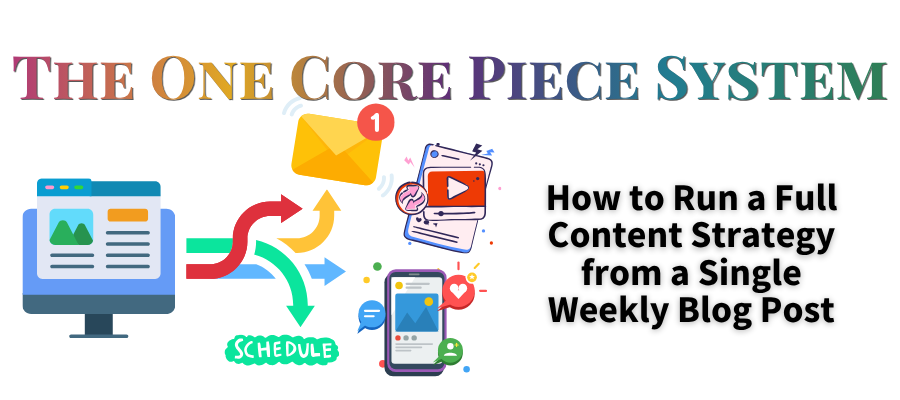
Most romance authors are creating content per platform — a separate idea for Instagram, a separate idea for Pinterest, a separate idea for email. They are working five times as hard for one-fifth the compound effect. Here’s the architecture that changes that.
There’s a content creation trap that almost every romance author falls into eventually.
She knows she needs to show up consistently. She knows she needs to be on multiple platforms. She knows every platform has its own format, its own best practices, its own algorithm. So she creates separately for each one — a caption here, a reel there, a pin somewhere else, an email that is completely different from all of them — and she ends up spending enormous creative energy producing content that does not build on itself, does not compound, and does not point anywhere permanent.
This isn’t a discipline problem. It’s an architecture problem.
The One Core Piece System is the architecture that solves it.
What the One Core Piece System Is
One blog article. Published once. Built with the full Semantic Fingerprint keyword architecture. Earning citations from the day it publishes until the end of its relevance — which, for romance content anchored to specific characters and worlds, is indefinitely.
From that one article:
- an email
- a carousel
- a short-form video hook
- a Pinterest pin
- a quote graphic
- a Threads or short-text post.
Every extraction requires editing, not new thinking. The ideas are already in the article. The work is packaging.
Every extraction links back to the article. Not to a product. Not to an opt-in. To the article.
Because the compound builds from the citation — and every piece of social content that points to the same permanent owned asset is sending the same relevance signal to every algorithm simultaneously.
This is the compound content strategy in its operational form. Not a theory. A weekly production order.
The Weekly Order of Operations
The order matters. Permanent asset first. Temporary content from it. Never the reverse.
Step 1 — Write the blog article.
This is the source document. It contains everything. Full keyword architecture applied — Level 7 and 8 emotional language in the first sentence, Level 3 and 4 structural keywords in the title and headers, Level 9 branded terms always paired with a searchable Level 7 term. The call to action points to the paid implementation layer or the free resource vault — not to a social platform.
The article is built to last, built to be found, built to be the permanent asset everything else extracts from.
Step 2 — Record the video.
The blog article is the script framework. You’re not writing two separate pieces — you’re teaching the article on camera. Same content, different container. Same ideas, different energy. The video earns YouTube search authority while the article earns Google search authority.
Both point to the same world. Both compound. The video embeds in the article on publish day — creating the bidirectional link that signals richer, more authoritative content to both platforms simultaneously.
Step 3 — Send the email.
The week’s email to your list is a warmer, shorter version of the blog post. Two to three paragraphs. One link back to the full article. Not to the product. Not to the social post. To the article. The reader who wants more follows the link. The compound builds from the citation.
Step 4 — Extract the social content.
Every article contains five extraction points. Each one requires editing, not creation.
The hook sentence — the sharpest, most stop-worthy single sentence in the article. Becomes the short-form video hook and the short-text post. Delivered on camera for thirty seconds or written as a standalone Threads post.
The framework or list — the structured element, the numbered sequence, the named framework. Becomes the carousel. One item per slide. The final slide is the call to action pointing back to the article.
The most quotable declarative statement — the line that states the core argument most boldly. Becomes the quote graphic and the Pinterest pin text. The line that would look good on a bookmark.
The emotional core moment — the Mirror Moment, the before-and-after, the highest emotional weight in the article. Becomes the long-form social caption. The one that earns saves and shares because it makes people feel something.
The visual concept — the image, scene, or detail that translates most naturally into a visual. Becomes the aesthetic post or the reel visual concept.
Step 5 — Schedule.
Article publishes on the anchor day. Email goes that same day. Long-form caption the next day. Short-form video the day after. Quote graphic. Carousel. Pinterest pin. One piece per day across the week.
By the end of the week, seven pieces of content have been produced from one article, and all of them are pointing back to the same permanent asset.
What This Looks Like With Real Content
From the Harlow Creek world: a blog article called “Why Romance Books Are Full of Content You Can’t See Yet” — a piece about how every story detail, character decision, and scene in an existing book is raw material for a complete content strategy.
From that one article:
The email opens: “You already have everything you need. It’s inside the books you’ve already written.” Two paragraphs. Link to the full article.
The carousel breaks the article’s framework into one slide per type of story material: characters, scenes, research, inspiration, series thread. Five slides. Final slide: “The complete system for turning your books into a content strategy — link in bio.”
The short-form video opens with the hook sentence on camera: “The most powerful content you could post today is already written. It’s in chapter twelve of the book you published two years ago.” Thirty seconds. Done.
The quote graphic pulls the sharpest declarative line: “Your backlist is not behind you. It is an untapped compound asset waiting to be built into.”
The long-form caption tells the story of the September 14th detail from the Harlow Creek world — the specific story element, the Mirror Moment underneath it, the human truth it names. Ends with: “This is the detail that becomes the content. The full system is at the link.”
The Pinterest pin carries the quote graphic image with a keyword-anchored description: “Romance author content ideas from your existing books — your story details, characters, and emotional arcs are a complete content library.”
One article. Seven pieces. All pointing back to the same URL. All compounding the same permanent asset from seven directions simultaneously.
Why This Works When Per-Platform Creation Doesn’t
The fundamental difference is citation concentration.
When an author creates separately per platform — a unique idea for Instagram, a different unique idea for Pinterest, a completely different email — she’s dispersing her creative energy and dispersing her citation signals. Each piece earns its own modest reach. Nothing compounds on anything else. The work multiplies but the compound does not.
When an author creates one strong core piece and extracts everything from it, every citation points to the same place. The algorithm on each platform reads the article differently, but every algorithm’s citation signal points to the same permanent owned asset. The effect of six simultaneous citations from six different platforms on the same URL is not six times the effect of one citation.
It’s exponentially more — because the compound builds from consistency of direction, not from volume of effort.
The author who creates one excellent article per week and extracts five social pieces from it will, within six months, have a content ecosystem that’s visibly stronger than the author who posts six times per day on separate ideas.
Because one of them is building permanent infrastructure. The other is maintaining a presence.
The Anti-Burnout Architecture
This is the part that’s worth naming directly, because it changes the sustainability of the whole system.
Original content creation is cognitively expensive. Every time you sit down to think of a new idea, write from scratch, and produce something that did not exist before, you’re drawing from the creative well. That well has limits. Most authors hit those limits and either post sporadically or produce content that’s lower quality than their work deserves.
The One Core Piece System is designed around one cognitively expensive act per week: writing the article. Everything else is editing. Editing is less expensive. Editing does NOT require original thinking. Editing is repeatable indefinitely without burnout.
The author who writes one excellent article per week and edits five extractions from it isn’t doing less than the author who creates six original pieces. She’s doing the same total work more efficiently — concentrating the expensive thinking into the piece that earns the most compound value, and letting that piece do the work of five.
The complete content architecture this system operates inside — including the compound content strategy, the Semantic Fingerprint keyword deployment, and the blog as the anchor of the owned ecosystem — is in BFF University Module 2, the Reader-First Platform and Ecosystem.
Your Story Notebook walks through the excavation of every piece of story material that becomes the source content for this system — characters, scenes, world details, research, author notes, series threads. Learn more.